Keratin essential for embryonic development
Without the structural protein keratin, cells in the embryo cannot move properly and the tissue breaks down during early development. This has been shown for the first time by a study by the Institute of Science and Technology Austria (ISTA). The results, published in “Nature Communications”, illustrate the central role of keratin not only for hair, nails and horns, but also for fundamental processes in the vertebrate embryo.
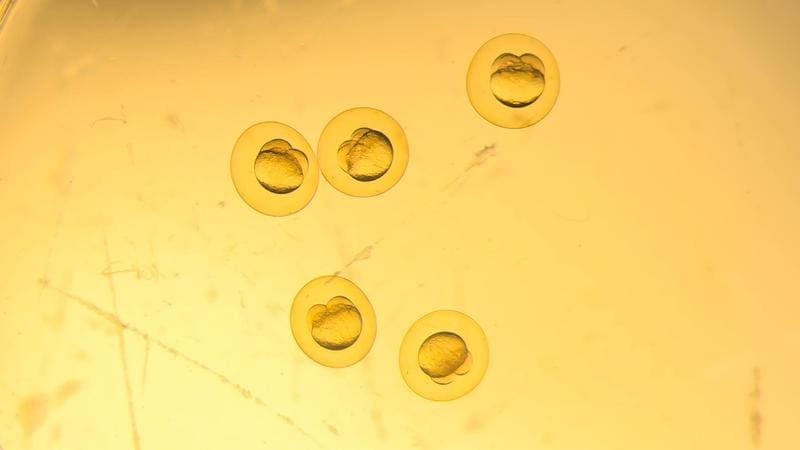
During gastrulation – the crucial phase in which the cells of the embryo rearrange themselves and the three germ layers are formed – the so-called epibolism takes place in zebrafish. In this process, a layer of cells migrates over the yolk like a stretching hood and envelops the entire embryo. Keratin plays a decisive role in this process.
The research group led by Suyash Naik from Edouard Hannezo’s Heisenberg group at ISTA, together with colleagues from Sorbonne Université and Leiden University, studied zebrafish embryos. With the help of the CRISPR-Cas9 gene scissors, they removed the keratin in the cells. The consequence was dramatic: the epibolism slowed down significantly, the cell tissue became softer and finally collapsed. The cells aligned themselves incorrectly, and the mechanical forces emanating from the yolk-syncytial layer could no longer be transmitted properly.
“Keratin acts as an emollient and at the same time as a link in the power transmission,” explains Naik. The thread-like keratin filaments are part of the cytoskeleton and make the cells elastic enough to withstand the enormous stretches during epibolism. Without them, the necessary stability and coordination are missing.
Zebrafish are particularly well suited for such studies because their embryos are transparent and develop outside the mother. Just a few hours after fertilization, gastrulation can be observed live under the microscope. “Although their development differs from mammals, there are many evolutionary similarities,” Naik points out.
The findings go far beyond basic research. A better understanding of the role of keratin could help to better understand processes such as wound healing and tissue regeneration. In addition, the study provides new insights into diseases such as epidermolysis bullosa (“butterfly disease”), in which mutations in the keratin gene lead to extremely fragile skin and blistering.
Lewis Wolpert, British developmental biologist, once described gastrulation as the most important moment in life – even more important than birth, marriage or death. The ISTA study underlines this statement: If the process is disrupted by the absence of a single protein such as keratin, the entire early development fails.
The project was funded by the EU’s Horizon 2020 programme and the Austrian Science Fund FWF, among others. The results show once again how mechanical properties of cells and tissues control fundamental biological processes.
Original Paper:
Editor: X-Press Journalistenbüro GbR
Gender Notice. The personal designations used in this text always refer equally to female, male and diverse persons. Double/triple naming and gendered designations are used for better readability ected.
Most read
 Hantavirus: detection, symptoms, therapy What is hantavirus? Hantaviruses are a group of viruses that occur worldwide and are mainly transmit...
- Impending fuel shortage: “If the laboratory fails, medical care will come to a standstill in large parts” DGKL CEO Jan Wolter explains the dramatic consequences of a potential fuel shortage for laboratory m...
- Hantavirus: Facts instead of panic Reports of three deaths in connection with a hantavirus outbreak on the cruise ship "MV Hondius" in...