
Hantavirus: Facts instead of panic
Reports of three deaths in connection with a hantavirus outbreak on the cruise ship “MV Hondius” in the Atlantic Ocean have attracted worldwide attention. In Germany, however, the disease has been known for years and is usually well controlled. Severe courses are rare, and transmission from person to person does not occur with the virus types found here. The Robert Koch Institute (RKI) emphasizes: The risk can be significantly reduced by simple precautionary measures.
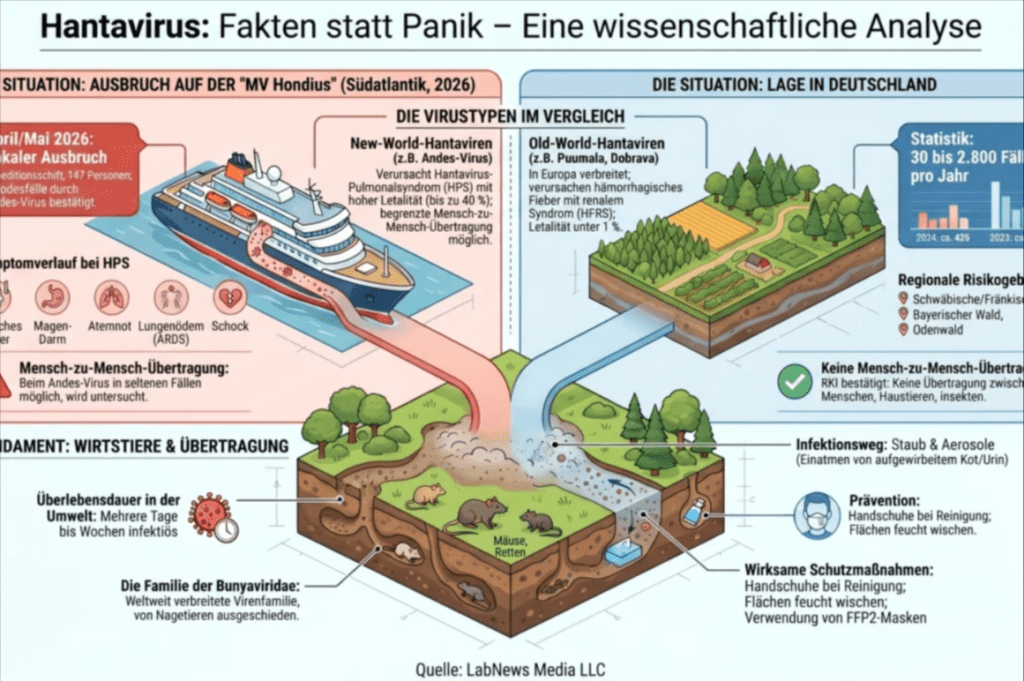
Hantaviruses belong to the Bunyaviridae family and are transmitted worldwide by rodents such as mice and rats. The animals themselves do not fall ill, but excrete the viruses throughout their lives via saliva, urine and faeces. In Germany and Central Europe, two types in particular are relevant: the Puumala virus (transmitted by rubella mice) and the Dobrava-Belgrade virus (mainly Kurkino variant, transmitted by fire mice). Both cause hemorrhagic fever with renal syndrome (HFRS), often in the mild form of nephropathia epidemica. In contrast, certain American hantaviruses can trigger hantavirus pulmonary syndrome (HPS/HCPS), which can cause severe damage to the lungs .
The outbreak on the “MV Hondius”
The Dutch expedition ship with around 147 people on board (passengers and crew) had set off from Ushuaia in Argentina at the beginning of April 2026 and had made stops in Antarctica, South Georgia and other remote South Atlantic islands. By the beginning of May 2026, several cases had been reported, including laboratory-confirmed hantavirus infections and suspected cases. Three people have died, others have been treated in intensive care.
- Confirmed virus type: It is the Andes virus (Orthohantavirus andesense), a New World hantavirus found in South America (including Argentina, Chile) that causes severe hantavirus pulmonary syndrome (HPS). This virus is responsible for a high lethality rate of up to 40 percent in the Americas.
- Deaths: A Dutch man (about 70 years old) died on board on April 11. His wife (69 years old) died after disembarkation in South Africa. A third person (German national) also died in connection with the outbreak. A British passenger tested positive and received intensive treatment. Symptoms included fever, gastrointestinal discomfort, and rapid worsening to respiratory distress, ARDS, and shock.
In contrast to the European types, the Andes virus can be transmitted from person to person in rare cases through close and prolonged contact – this is currently being investigated in connection with the outbreak. However, most hantaviruses (including those found in Germany) are purely zoonotic and not transmissible between humans.
Transmission exclusively from animals to humans (for European types)
The infection almost always occurs by inhaling aerosols containing the virus – such as dust stirred up from dried feces or urine in barns, sheds, cellars or during gardening. Direct contact with contaminated surfaces via injured skin or, rarely, bites are also possible. The viruses remain infectious in the environment for several days to weeks. Infection via food is theoretically conceivable. Important: There is no transmission from person to person with the viruses circulating in Germany, not even via pets or insects. This is confirmed uniformly by the RKI.
Incubation period and symptoms
After infection, it usually takes two to four weeks (range: five days to two months) before symptoms appear. Many infections are asymptomatic or mild, with the typical onset being a sudden high fever, headache, backache, abdominal pain, aching limbs, nausea. HPS (as with the Andes virus) is followed by rapid progression to pulmonary edema, shortness of breath and shock. In European types, kidney problems dominate. The lethality rate is less than one percent for European types, and significantly higher for American HPS cases.
Case numbers fluctuate greatly – but remain manageable
Since the introduction of the reporting obligation in 2001, between a few dozen and a maximum of around 2800 cases have been registered in Germany every year (e.g. peaks around 2012, most recently in 2024 approx. 425, in 2025 approx. 293 cases). Strong fluctuations are related to rodent populations. Most reports come from rural risk areas such as the Swabian Alb, Franconian Alb, Bavarian Forest or Odenwald. Since 2001, only very few deaths nationwide.
Diagnosis, therapy and prevention
Diagnosis via antibody detection or PCR. No specific antiviral therapy or vaccination in Europe. Treatment is symptomatic, in severe cases intensive care (fluid management, ventilation). The only effective measure is exposure prophylaxis: keep rodents away, use FFP2 masks, gloves and damp wiping during cleaning work.
Current forecast models predict medium to increased risks in some regions in 2026 – but the nationwide risk for the general population remains low. The outbreak on the “MV Hondius” is a local event with possible exposure in rodent areas of South America or on the ship; it does not change the low risk in Central Europe.
Conclusion: Hantavirus is not a new threat, but a known zoonosis. The current shipwreck with the Andes virus underlines the higher dangerousness of American variants and the rare possibility of limited human-to-human transmission in this type. Panic is unfounded. Those who are careful in risk areas or in the event of contact with rodents protect themselves effectively. In the case of flu-like symptoms, consult a doctor after possible contact with mouse droppings or urine and point out hantavirus.
Sources
- World Health Organization (WHO): Outbreak News on Hantavirus on MV Hondius (2026)
- BBC News: Reports on the hantavirus outbreak on the cruise ship (May 2026)
- Robert Koch Institute (RKI): Guide to Hantavirus Infections and Current Case Numbers
- Proplanta.de / RKI data: Overview of hantavirus case numbers Germany 2024/2025
- CDC and Literature: Information on the Andes Virus and Transmission Routes
The article was originally published by LabNews Media LLC
Editor: X-Press Journalistenbüro GbR
Gender Notice. The personal designations used in this text always refer equally to female, male and diverse persons. Double/triple naming and gendered designations are used for better readability ected.
Most read
 Wal Timmy: Environment Minister Backhaus ignored rescue technology that has been in place since 1983 The stranded humpback whale "Timmy" suffered severely for days in Mecklenburg-Western Pomerania beca...
- Wal Timmy: Germany’s problem with euthanasia EDITORIAL. Letting Timmy suffer is more due to the German lack of experience and the bureaucratic hu...
- Impending fuel shortage: “If the laboratory fails, medical care will come to a standstill in large parts” DGKL CEO Jan Wolter explains the dramatic consequences of a potential fuel shortage for laboratory m...