
The 70 percent claim of laboratory medicine: How much truth is behind the famous number?
The famous sentence “70 percent of all diagnoses (or medical decisions) are based on laboratory findings” is one of the most frequently quoted mnemonics in laboratory medicine worldwide – also in Germany. It is regularly used by professional societies, clinics and associations to underline the central importance of laboratory diagnostics.
Where does the number come from exactly?
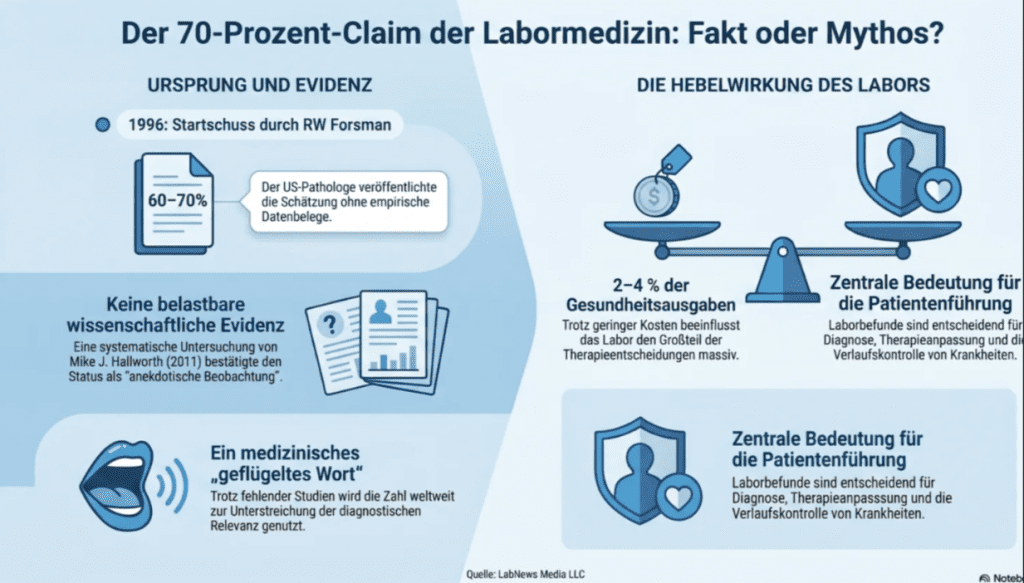
The claim does not have an exact scientific origin in the form of a large, representative study. It is an estimate / expert statement from the USA:
- First published mention (1996):
The US pathologist RW Forsman (Mayo Clinic, Rochester) wrote in an article in the journal Clinical Chemistry:
“We know that, although the laboratory represents a small percentage of medical center costs, it leverages 60–70% of all critical decisions, e.g. admission, discharge and therapy.”
Forsman did not cite any data or study as evidence. It was an estimate based on empirical values by a hospital laboratory manager.
- Other early sources (1990s/2000s):
Similar formulations appeared in reports from the College of American Pathologists (CAP) and in conversations with other US pathologists (e.g., Peter Dysert, Baylor University). Here, too, hard empirical data was missing. - Distribution in Europe and Germany:
From the 2000s onwards, the number was adopted by European and German laboratory medicine associations – often as “up to 70%” or “around 70%”. It appeared in position papers, press releases and lectures, without ever citing a specific German or European study as a source.
Important critical classification (2011)
In 2011, the British laboratory physician Mike J. Hallworth systematically examined the claim in a much-noticed editorial in Annals of Clinical Biochemistry (title: “the ‘70% claim’: what is the evidence base?”). His conclusion:
- There is no reliable scientific evidence for the exact 70 percent figure.
- The statement is based on anecdotal observations, expert estimates and unpublished internal data from US hospitals.
- Nevertheless, it has been passed on for decades as a “winged word” – similar to an urban myth in medicine.
Hallworth and later authors emphasize, however, that even if the exact percentage is not proven, it reflects a fundamentally correct assessment . In practice, laboratory findings influence a very large part of medical decisions (diagnosis, therapy, follow-up).
Conclusion
The 70 percent claim is not an exact scientific measurement, but a memorable estimate from the USA that has been repeated since 1996. It has become a strong professional policy argument to illustrate the enormous leverage effect of laboratory medicine: laboratory tests account for only 2-4% of healthcare spending, but influence a large part of medical decisions.
Today, it is usually cautiously formulated as “up to 70%” or “around 70%” – and this is exactly how it is used in Germany.
The article was originally published by LabNews Media LLC.
Editor: X-Press Journalistenbüro GbR
Gender Notice. The personal designations used in this text always refer equally to female, male and diverse persons. Double/triple naming and gendered designations are used for better readability. ected.
Most read
 Wal Timmy: Environment Minister Backhaus ignored rescue technology that has been in place since 1983 The stranded humpback whale "Timmy" suffered severely for days in Mecklenburg-Western Pomerania beca...
- Wal Timmy: Germany’s problem with euthanasia EDITORIAL. Letting Timmy suffer is more due to the German lack of experience and the bureaucratic hu...
- Impending fuel shortage: “If the laboratory fails, medical care will come to a standstill in large parts” DGKL CEO Jan Wolter explains the dramatic consequences of a potential fuel shortage for laboratory m...