Laser rotates microscopic samples in all spatial directions without contact
Researchers of Karlsruhe Institute of Technology (KIT) have developed a novel laser-based method that can be used to rotate sensitive microscopic objects such as cells or cell components in all three spatial directions without contact. The technology enables much more accurate 3D images and protects the samples.
The team led by Professor Moritz Kreysing and Dr. Fan Nan from the Institute of Biological and Chemical Systems uses a laser to generate targeted, minimal temperature differences in the surrounding liquid. This creates fine currents that allow the free-floating sample to move and rotate smoothly – without any mechanical contact from pipettes, needles or grippers.
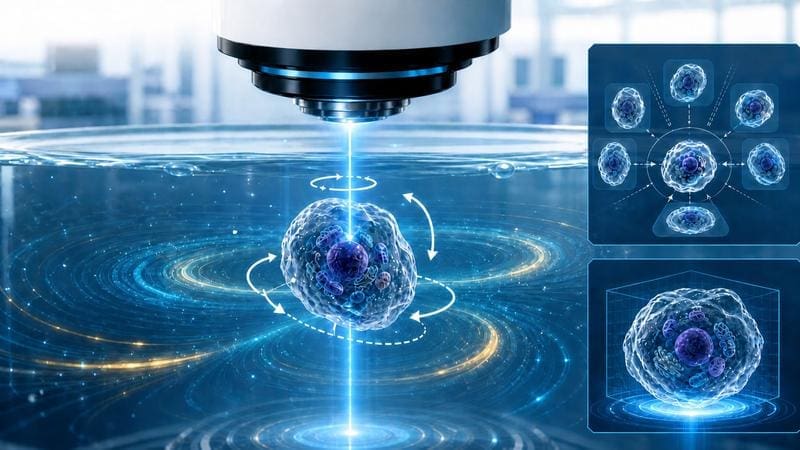
While previous laser-induced flows only allowed movements in one plane, the researchers have now succeeded in realizing controlled rotations in three-dimensional space. Rapid scanning with the laser creates a helical flow that rotates the object as if in a gentle vortex.
The new method is particularly relevant for basic medical research and the study of living cells. Previous microscope images provide high-resolution images in one plane, but they are often inaccurate at depth. By rotating the sample in a targeted manner, structures can be captured from different angles and assembled into precise 3D models.
Professor Moritz Kreysing explained that samples can be aligned more precisely and thus more details become visible. This is a central prerequisite for a better understanding of biological structures and processes. In the long term, the technology could also be interesting for contactless micromanipulation, microscopic robotics or precise manufacturing processes on a very small scale.
The study has been published in the journal Light: Science & Applications .
Original Paper:
Read Also:
Editor: X-Press Journalistenbüro GbR
Gender Notice. The personal designations used in this text always refer equally to female, male and diverse persons. Double/triple naming and gendered designations are used for better readability ected.
Most read
 Wal Timmy: Environment Minister Backhaus ignored rescue technology that has been in place since 1983 The stranded humpback whale "Timmy" suffered severely for days in Mecklenburg-Western Pomerania beca...
- Hantavirus: detection, symptoms, therapy What is hantavirus? Hantaviruses are a group of viruses that occur worldwide and are mainly transmit...
- Impending fuel shortage: “If the laboratory fails, medical care will come to a standstill in large parts” DGKL CEO Jan Wolter explains the dramatic consequences of a potential fuel shortage for laboratory m...