
Emergence explains the transition from the inanimate to the living
Many properties of molecules cannot be derived from the properties of the individual atoms that make them up. These new properties only emerge in combination – a phenomenon that science calls “emergence”. An interdisciplinary study by Goethe University Frankfurt examines from a chemical, biological and philosophical point of view how emergence and complexity are related and how systems can emerge from simple building blocks over many intermediate steps that store information, replicate itself and finally perform functions.
The publication shows that emergence is a central mechanism in the transition from inanimate to animate nature. A vivid example is water: it consists of two hydrogen atoms and one oxygen atom. It is only in the compound that the polarity of the molecule arises, which makes it liquid and thus creates the basis for life on Earth. This polarity imposes a certain order on more complex molecules such as DNA – similar to a conductor who holds the musicians together.
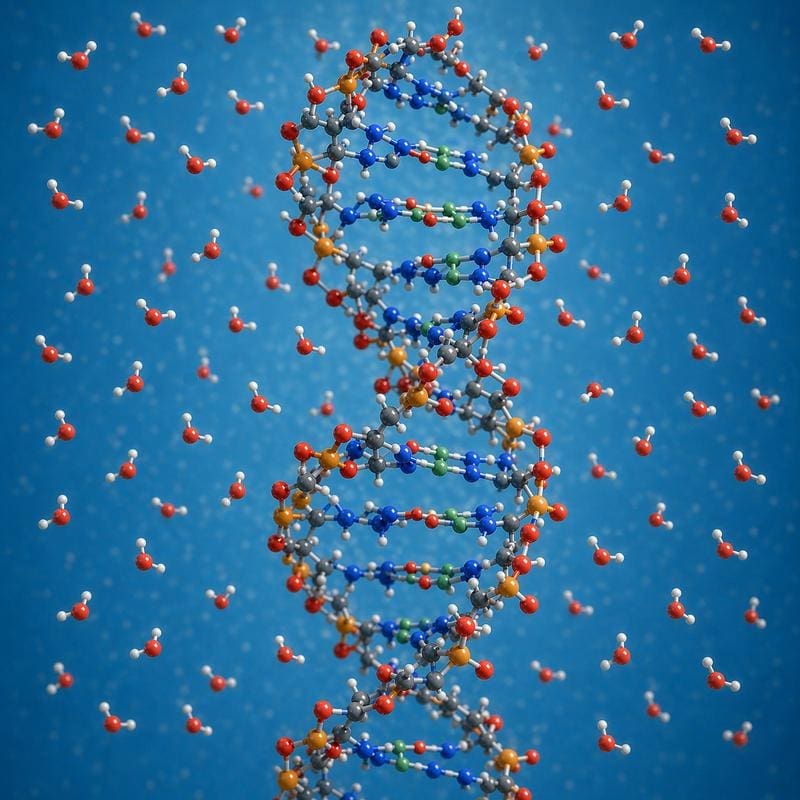
The DNA structure itself is another example of emergence. Polar and non-polar building blocks form the characteristic double helix in an aqueous environment, which in turn enables the ability to replicate. The researchers describe a total of 13 characteristics of complex systems, including the achievement of critical states in which properties suddenly change fundamentally.
Prof. Harald Schwalbe from the Institute of Organic Chemistry and Chemical Biology at Goethe University Frankfurt emphasizes that evolutionary mechanisms were already at work in molecules before the emergence of life. Nevertheless, the exact development is not predetermined: If the clock were to be turned back four billion years, completely different life forms would probably emerge.
The study contributes to a better understanding of the origin of life. It shows that emergence plays a central role not only in chemistry and biology, but also in philosophy. The results have been published in the journal Angewandte Chemie International Edition .
The work is part of a broader research approach that sheds light on the emergence of complex systems in an interdisciplinary manner. It provides new impetus for the question of how living organisms could have arisen from simple chemical compounds – a process that would not be repeated exactly even if the clock could be turned back.
Original paper:
Editor: X-Press Journalistenbüro GbR
Gender Notice. The personal designations used in this text always refer equally to female, male and diverse persons. Double/triple naming and gendered designations are used for better readability ected.
Most read
 Wal Timmy: Environment Minister Backhaus ignored rescue technology that has been in place since 1983 The stranded humpback whale "Timmy" suffered severely for days in Mecklenburg-Western Pomerania beca...
- Wal Timmy: Germany’s problem with euthanasia EDITORIAL. Letting Timmy suffer is more due to the German lack of experience and the bureaucratic hu...
- Impending fuel shortage: “If the laboratory fails, medical care will come to a standstill in large parts” DGKL CEO Jan Wolter explains the dramatic consequences of a potential fuel shortage for laboratory m...