AI tool maps disease-related changes in the entire mouse body for the first time
For the first time, a new AI-supported framework enables high-resolution whole-body analyses of intact mice, revealing previously unknown systemic damage in obesity. Researchers from Helmholtz Munich and the Ludwig Maximilian University of Munich have used the “MouseMapper” platform to demonstrate extensive inflammatory processes as well as structural damage to sensory facial nerves in obese mice. Many of the molecular changes could also be detected in human tissue.
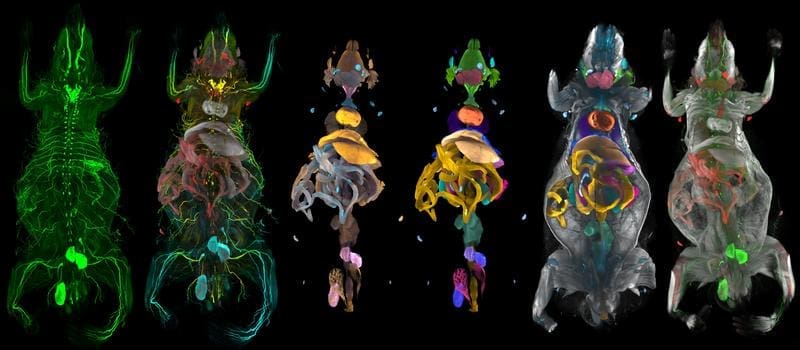
The “MouseMapper” platform is based on deep learning algorithms and so-called foundation models. It automatically segments 31 organs and tissue types while simultaneously mapping nerve and immune cells throughout the body. This enables comprehensive multiorganic analyses in intact mice without the need to define specific regions beforehand.
For the study, the scientists labeled nerve and immune cells in mice with fluorescent markers, made the animals transparent using special tissue clarification techniques and created three-dimensional whole-body images using high-resolution light sheet microscopy. The AI then analyzed the huge data sets fully automatically.
In mice that had developed obesity and metabolic disorders comparable to humans due to a high-fat diet, MouseMapper showed pronounced systemic changes in the organization of immune cells and in nerve architecture. Damage to the trigeminal nerve, an important sensory facial nerve, was particularly striking. In obese mice, the nerve endings were significantly reduced and less branched. Behavioral experiments confirmed impaired sensory perception in the facial area.
In addition, the researchers analyzed the trigeminal ganglion and identified molecular signatures of nerve remodeling and inflammatory processes there. Many of these molecular changes were also found in the trigeminal tissue of people with obesity. This suggests that central features of obesity-related nerve damage are preserved across the species boundary.
Obesity not only alters metabolism and adipose tissue, but also affects immune activity, nerve structure, and tissue organization in numerous organ systems, increasing the risk of type 2 diabetes, cardiovascular disease, neuropathies, and cancer. Until now, however, there has been a lack of suitable tools to investigate such disease-related changes in the entire intact organism in high resolution.
The new platform could fundamentally change the way we study complex systemic diseases such as diabetes, cancer, neurodegenerative and autoimmune diseases. In contrast to conventional methods, which usually focus on individual organs, MouseMapper enables integrated whole-body observation and the identification of disease-related hotspots throughout the organism.
The researchers have made the extensive whole-body datasets publicly available. In the long term, they aim to develop realistic digital twins of mice that could be used to simulate disease progression, detect early changes and accelerate new therapies – while reducing the number of animal experiments.
Original Paper:
Kaltenecker et al., 2026: A deep-learning framework reveals whole-body perturbations at cell level. Nature. DOI: 10.1038/s41586-026-10535-2
Editor: X-Press Journalistenbüro GbR
Gender Notice. The personal designations used in this text always refer equally to female, male and diverse persons. Double/triple naming and gendered designations are used for better readability ected.
Most read
 Hantavirus: detection, symptoms, therapy What is hantavirus? Hantaviruses are a group of viruses that occur worldwide and are mainly transmit...
- Impending fuel shortage: “If the laboratory fails, medical care will come to a standstill in large parts” DGKL CEO Jan Wolter explains the dramatic consequences of a potential fuel shortage for laboratory m...
- Hantavirus: Facts instead of panic Reports of three deaths in connection with a hantavirus outbreak on the cruise ship "MV Hondius" in...