
And that’s not all: Cats make virtual meetings more human
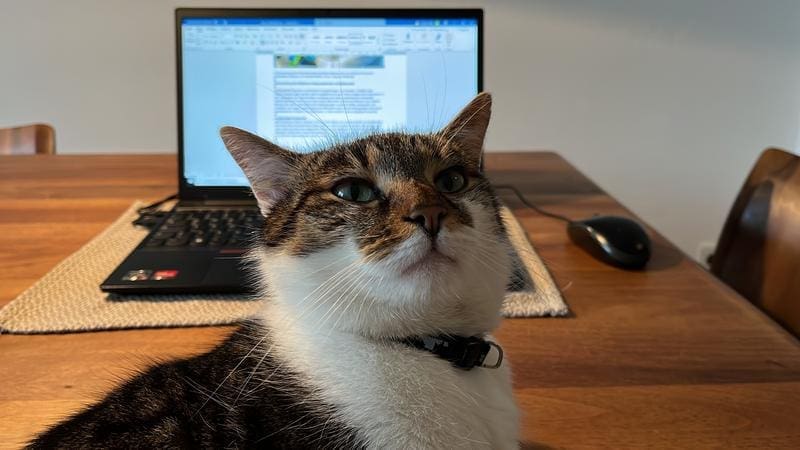
Cats on the desk or an exercise ball in the background: Such everyday moments in video conferences not only act as a disturbance, but can also make virtual meetings much more human and closer. This is the result of a dissertation by the Munich University of Applied Sciences.
Galina Gostrer from the Department of General Studies and Interdisciplinary Studies at the University of Applied Sciences examined so-called noticing sequences in her work. These are short episodes in which participants notice and address something from the private everyday life of the others. These situations add a personal touch to video conferencing and encourage relationship building.
Gostrer analyzed 44 recorded virtual meetings between two teams using multimodal conversation analysis. In doing so, she took into account not only spoken words, but also facial expressions, gestures and spatial contexts. The results show that these moments occur at different points – for example, as small talk at the beginning, during breaks or to relieve tension. Participants transfer physicality into the digital world by waving, imitating movements or describing physical sensations.
The doctoral student sees great potential for practice in this. Virtual meetings are here to stay. Used correctly, noticing sequences could create closeness and strengthen social interaction. Instead of being a disturbance, they should be seen as an opportunity.
The dissertation entitled “Celia, are you sitting at a ball? Negotiation of Relationship and Space by Noticings of Co-Present Phenomena in Virtual Meetings” will be published by De Gruyter Brill in June. The work was supervised by Prof. Dr. Katharina von Helmolt from Munich University of Applied Sciences and Prof. Dr. Kirsten Nazarkiewicz from Fulda University of Applied Sciences.
Read Also:
Cat scratch disease (CCC) pathogen could cause psychosis and schizophrenia – MedLabPortal
Editor: X-Press Journalistenbüro GbR
Gender Notice. The personal designations used in this text always refer equally to female, male and diverse persons. Double/triple naming and gendered designations are used for better readability ected.
Most read
 Wal Timmy: Environment Minister Backhaus ignored rescue technology that has been in place since 1983 The stranded humpback whale "Timmy" suffered severely for days in Mecklenburg-Western Pomerania beca...
- Wal Timmy: Germany’s problem with euthanasia EDITORIAL. Letting Timmy suffer is more due to the German lack of experience and the bureaucratic hu...
- Impending fuel shortage: “If the laboratory fails, medical care will come to a standstill in large parts” DGKL CEO Jan Wolter explains the dramatic consequences of a potential fuel shortage for laboratory m...