
Würzburg researchers discover pro-inflammatory mechanism in platelets
A team from the University Hospital Würzburg and the Rudolf Virchow Center has uncovered a novel mechanism in platelets that changes the understanding of their biology. The study, published in Science, shows that the surface protein integrin αIIbβ3 not only plays a key role in blood clotting, but can also have a pro-inflammatory effect in severe diseases.
Platelets are nucleated blood cells that become active in vascular injury to form blood clots and stop bleeding. However, excessive activation can lead to thrombosis that triggers heart attacks or strokes. The researchers discovered that platelets switch during infections or infarctions and release thread-like membrane processes, so-called PITTs. PITT stands for Platelet-derived Integrin- and Tetraspanin-rich Tethers and contains plenty of αIIbβ3 and the tetraspanin co-receptor CD9.
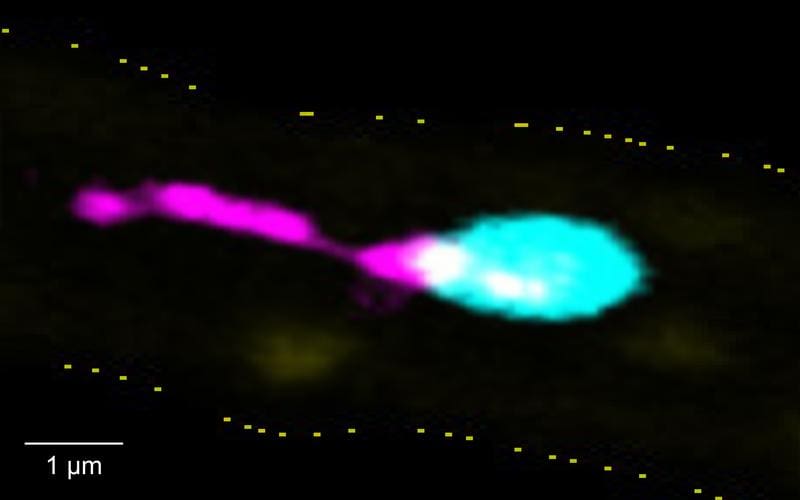
These PITTs bind to immune cells and the inflamed vessel wall, activate them and intensify inflammatory processes. The platelets themselves lose αIIbβ3 on their surface, become weakened and less adhesive. The mechanism was first observed in blood samples from patients with sepsis, bacterial infections and COVID-19. Intravital microscopy in mouse models confirmed that PITTs arise in inflamed vessels and drive inflammation.
Blockade of αIIbβ3 with monoclonal antibodies reduces PITT formation and mitigates severe inflammation and tissue damage in models. This opens up new approaches for the treatment of thrombo-inflammatory diseases without disrupting hemostasis.
The work was carried out as part of the DFG Collaborative Research Centre 1525 “Cardio-Immune Interfaces” and was funded by the ERC Advanced Grant “PITT-Inflame”. Würzburg groups as well as partners from France, Italy and the USA were involved.
Original Paper:
Platelet-derived integrin- and tetraspanin-enriched tethers exacerbate severe inflammation | Science
Editor: X-Press Journalistenbüro GbR
Gender Notice. The personal designations used in this text always refer equally to female, male and diverse persons. Double/triple naming and gendered designations are used for better readability. ected.
Most read
 First female dean in 549 years: Professor Sara Y. Brucker heads the Faculty of Medicine in Tübingen For the first time in its almost 550-year history, the Faculty of Medicine at the University of Tübi...
- Interview: KKH CEO Dr. Wolfgang Matz on billing fraud, AI and the future of statutory health insurance In an interview with MedLabPortal , Dr. Wolfgang Matz, Chairman of the Board of Directors of KKH Kau...
- Lifesaver laboratory medicine: “As a rule, a result should be available after 60 minutes at the latest for emergencies.” 11.2 is the day of the emergency call - but for laboratory medicine it is only one of 365 days on wh...