Würzburg: Magnetic particle imaging used on humans for the first time
Researchers at Julius-Maximilians-Universität Würzburg (JMU) and the University Hospital Würzburg (UKW) have applied magnetic particle imaging (MPI) in vivo to humans for the first time. The method enables radiation-free imaging of vascular structures and blood flow in real time.
In a feasibility study, a vascular imaging was performed on the arm of a healthy volunteer. Clinically approved iron oxide nanoparticles served as contrast agents and were injected into the bloodstream. A specially developed MPI scanner recorded their distribution. The most important superficial and deep veins of the arm, including branches, were visualized. The frame rate was two frames per second and was thus in the range of established clinical angiography procedures.
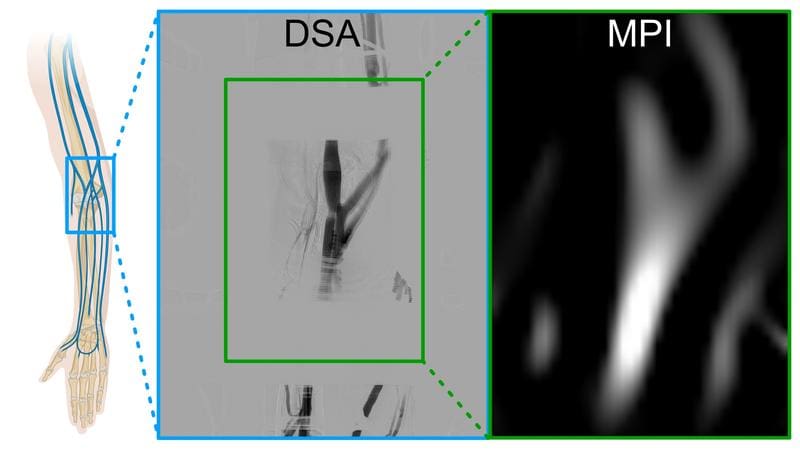
For comparison, digital subtraction angiography (DSA) was also performed as the current standard with X-rays. MPI produces images without ionizing radiation and without background signal from the surrounding tissue, resulting in high contrast and good temporal resolution.
The technology was developed in close collaboration between physics and radiology. The teams have been working at MPI for about 20 years – from physical fundamentals to experimental scanners and integration into clinical environments. The first application in humans marks the transition from preclinical research to the translational phase.
In the future, MPI could enable interventional interventions without radiation exposure. However, further studies are needed to systematically assess safety, efficacy and clinical benefit. The development is in the context of the recently approved South German Center for Magnetic Particle Imaging (SMPI) at JMU, which is funded by the German Research Foundation.
Editor: X-Press Journalistenbüro GbR
Gender Notice. The personal designations used in this text always refer equally to female, male and diverse persons. Double/triple naming and gendered designations are used for better readability. ected.
Most read
 First female dean in 549 years: Professor Sara Y. Brucker heads the Faculty of Medicine in Tübingen For the first time in its almost 550-year history, the Faculty of Medicine at the University of Tübi...
- New S3 guideline: ASA as an option for thrombosis prophylaxis in hip and knee surgery The updated S3 guideline for the prophylaxis of venous thromboembolism (VTE) recommends acetylsalicy...
- New MRI methods for the early detection of Parkinson’s disease: Campus Lübeck is looking for study participants Researchers at the University Medical Center Schleswig-Holstein (UKSH) and the Universities of Lübec...