
Universities of Leipzig and Shandong summarize therapeutic potential of adhesion GPCRs
Adhesion G protein-coupled receptors (adhesion GPCRs) play a central role in many human diseases, but there are currently no approved drugs that specifically target this receptor family. A research team from the University of Leipzig and Shandong University (China) has now summarized the current state of research and the high therapeutic potential of these signaling molecules in a comprehensive review. The publication was published in Nature Reviews Drug Discovery.
Of the 33 known human adhesion GPCRs, 17 are currently associated with specific clinical pictures. This results in a variety of starting points for the development of new therapies. The receptors form a large family of surface proteins that sense chemical and mechanical signals and are involved in the control of numerous physiological processes. The rapidly growing knowledge about their disease-relevant functions nourishes the expectation of an imminent transfer to the clinic.
For the first time, the review summarizes all known natural and synthetic modulators of adhesion GPCRs, analyzes their mechanisms of action and presents pharmacologically relevant data – including effective concentrations – in clear tables. The presentation is supplemented by a systematic overview of the physiological roles of the receptor family. Based on around 300 references, the publication condenses three decades of research and documents the transition from receptors with a long unclear function to promising drug targets.
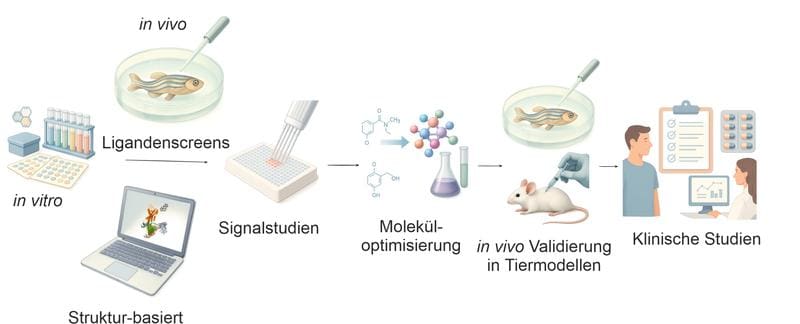
At the Rudolf Schönheimer Institute of Biochemistry at the University of Leipzig , selective active substances are currently being developed that specifically modulate individual signaling pathways of the adhesion GPCRs. One focus is on so-called biased agonists, which are intended to activate desired signaling cascades and reduce undesirable effects. Among other things, the focus is on metabolic disorders, cardiovascular diseases, myelination defects and tumor diseases.
Recently, the team reported the discovery of AP503, a highly specific activator of the adhesion GPCR GPR133. In preclinical mouse models, the substance improved muscle function and reduced bone resorption in osteoporosis. The current review in Nature Reviews Drug Discovery is the fourth joint publication of the Leipzig institute with the team led by Prof. Jin-Peng Sun from Shandong University in this renowned journal. Articles in Nature Reviews Drug Discovery are by invitation only and are considered decisive for the orientation of future drug development.
Adhesion GPCRs have been a central research focus at Leipzig University for more than ten years. Since 2019, the topic has also been worked on in the Collaborative Research Centre 1423 “Structural Dynamics of GPCR Activation and Signal Transduction”. Internationally, Leipzig is one of the leading locations in this field.
Original Paper:
Editor: X-Press Journalistenbüro GbR
Gender Notice. The personal designations used in this text always refer equally to female, male and diverse persons. Double/triple naming and gendered designations are used for better readability. ected.
Most read
 Interview: KKH CEO Dr. Wolfgang Matz on billing fraud, AI and the future of statutory health insurance In an interview with MedLabPortal , Dr. Wolfgang Matz, Chairman of the Board of Directors of KKH Kau...
- Psychotherapy: National Association of Statutory Health Insurance Funds plans blanket fee reduction of ten percent The professional association unith e.V. warns of an imminent blanket reduction of fees for psychothe...
- Lifesaver laboratory medicine: “As a rule, a result should be available after 60 minutes at the latest for emergencies.” 11.2 is the day of the emergency call - but for laboratory medicine it is only one of 365 days on wh...