
THRIVE module: StellarHeal wound care launched in space
On March 12, 2026, a REXUS research rocket was launched into the stratosphere from Sweden’s Esrange Space Center. On board was the THRIVE module with components of the cell-based wound care material StellarHeal, which is being developed by researchers from Würzburg, Hanover and Dresden. The experiment is intended to test whether the innovative materials and cells can survive a rocket launch and the associated stresses – a decisive step for possible applications in space.
StellarHeal combines a hemostatic fully bioresorbable fiber matrix with live skin cells and macrophages. The system is supposed to stop bleeding quickly, fight infections, prevent excessive scarring and do not require dressing changes. It is radiation-resistant and flexibly adaptable. It is being developed for the special challenges of space travel: weightlessness disrupts cell organization and growth, cosmic radiation weakens the immune system. Delayed healing, risks of infection and scarring can be the result. Astronauts must also be able to take care of themselves easily and efficiently.
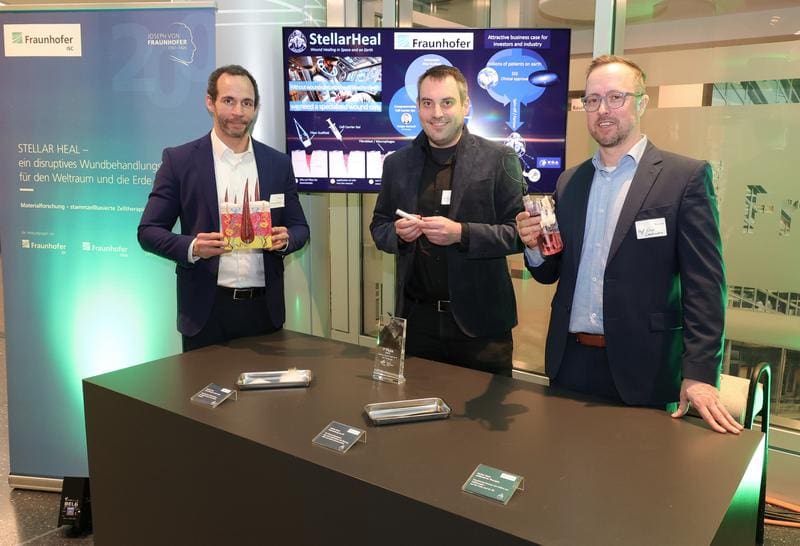
The Fraunhofer Institute for Silicate Research ISC (Würzburg), the Fraunhofer Institute for Toxicology and Experimental Medicine ITEM (Hanover) and the Institute for Air Conditioning and Refrigeration ILK (Dresden) are involved in the project. Fraunhofer ISC is developing skin organoids and the silica gel fiber fleece as a carrier material. Fraunhofer ITEM produces immune cells (macrophages) from stem cells, and ILK Dresden produces a cryoprotective carrier gel for the preservation and application of the cells.
The THRIVE experiment (Tissue Healing Research In-flight Viability Experiment) tests a specially developed, actively cooled transport module. It protects sensitive organic and inorganic components from thermal and mechanical stresses during flight, records accelerations and temperatures, and enables analysis after return. One set of samples flies into space, a second serves as ground control. The aim is to distinguish changes caused by the rocket launch from those caused by space conditions.
The REXUS program offers European students the opportunity to conduct experiments under real rocket conditions. For THRIVE, the technical assistant Ingrid Gensch (Fraunhofer ITEM) and the master’s students Markus Münig (Fraunhofer ISC) and Jonas Pfister (TH Würzburg-Schweinfurt) were involved.
After the rocket’s return, the samples are to be evaluated. The results form the basis for further development work on StellarHeal – with potential not only for space, but also for the treatment of chronic wounds on Earth.
Read Also:
Astronaut Omics: What Elon Musk can learn from Daniela Bezdan – MedLabPortal
Editor: X-Press Journalistenbüro GbR
Gender Notice. The personal designations used in this text always refer equally to female, male and diverse persons. Double/triple naming and gendered designations are used for better readability. ected.
Most read
 THRIVE module: StellarHeal wound care launched in space On March 12, 2026, a REXUS research rocket was launched into the stratosphere from Sweden's Esrange...