Sugar impairs the body’s ability to relax
Taking sugar counteracts relaxation exercises. A study by the University of Konstanz shows that elevated blood sugar levels keep the sympathetic nervous system of the autonomic nervous system at a higher level of activity during relaxation, thus limiting the body’s ability to recover.
Sugar intake in stressful situations is known to increase cortisol release and increase heart rate for longer. Less research has been done so far on the influence on relaxation phases. The research group led by neuropsychology professor Jens Pruessner investigated this question in a study published in the “International Journal of Psychophysiology”.
94 healthy adults took part in the study. After arriving at the laboratory on an empty stomach, some of the test subjects drank a sugary drink, the other part water. Afterwards, half of each half received a relaxing massage, while the other half simply rested. Cardiac activity was measured continuously. The heart rate variability as a measure of parasympathetic activity and the prejection period as an indicator of sympathetic activity were evaluated.
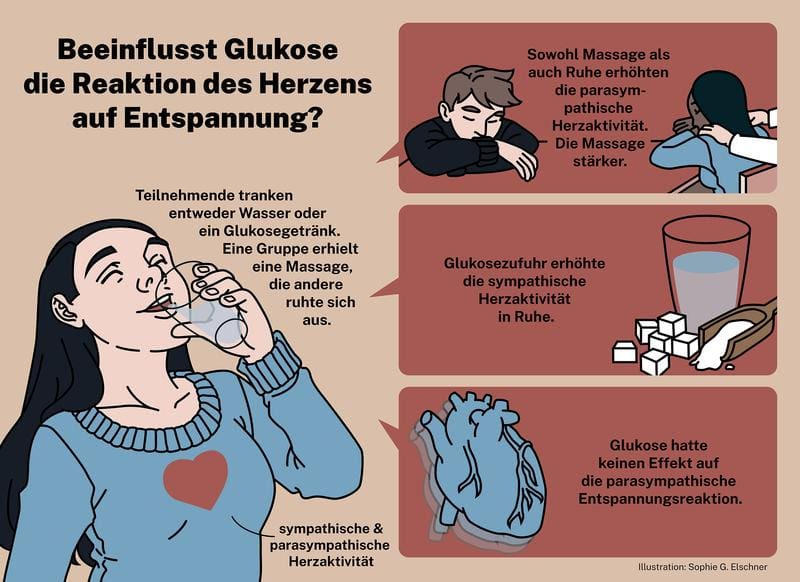
The results show that both the massage and the resting phase activated the parasympathetic nervous system and were subjectively perceived as relaxing by the participants – regardless of whether sugar had been ingested beforehand. The massage led to greater relaxation than just resting. After sugar administration, however, the sympathetic nervous system remained at a higher level of activity during the relaxation phase. The body thus remained in an increased state of arousal, although the test subjects subjectively felt relaxed.
The researchers conclude that sugar impairs the ability to relax deeply. Especially in the case of conscious relaxation techniques such as meditation or progressive muscle relaxation, sugary foods should be avoided immediately beforehand.
The study also highlights the need to consider both the sympathetic and parasympathetic nervous systems when studying the autonomic nervous system in order not to overlook hidden effects.
Read Also:
Editor: X-Press Journalistenbüro GbR
Gender Notice. The personal designations used in this text always refer equally to female, male and diverse persons. Double/triple naming and gendered designations are used for better readability. ected.
Most read
 Miraculous fitness probiotic: Roseburia inulinivorans massively improves muscle strength Researchers from the University of Granada, the University of Almería and the Leiden University Medi...
- DGKL board member Jan Wolter calls for comprehensive health tax instead of pure sugar tax Jan Wolter, chairman of the German Society for Clinical Chemistry and Laboratory Medicine (DGKL), ha...
- ASKED: “The new GOÄ is a far greater danger than some people realize” The new fee schedule for doctors (GOÄ) provides for significant cuts for laboratory medicine. DGKL b...