
Reef diff enables design of high-performance enzymes
Researchers at the Graz University of Technology and the University of Graz have developed a new technology that can be used to construct artificial biocatalysts. These enzymes are faster, more stable and more versatile than previous artificial variants. The method, called reef diff, builds the protein structure specifically around the active site instead of looking for suitable structures from databases. The results were published in the journal Nature and promise progress in industry, medicine and environmental protection.
Enzymes are becoming increasingly important in chemical production, drug manufacturing and environmental cleaning. They enable more environmentally friendly synthesis of chemicals, targeted active ingredient production and degradation of harmful substances. Previous artificial enzymes were often unstable and less efficient. The new technology uses machine learning models to design complex structures. First, structural motifs are placed around the active site, then the model trained with protein data generates the complete molecular structure. Other models refine the framework so that chemically active elements are precisely positioned – with Angstrom-level accuracy.
The method enables a one-shot process in which enzymes are efficiently designed for specific reactions. Laboratory tests showed that active enzymes for different reaction types were created from 35 sequences. These catalysts were more active than previous computer-aided designs and could withstand temperatures above 90 degrees Celsius, making them suitable for industrial applications. The screening and optimization effort is drastically reduced, making enzyme design more accessible to biotechnology.
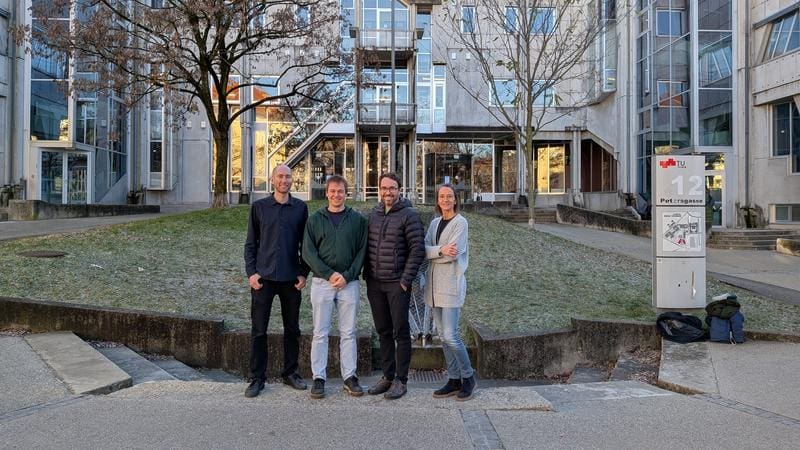
The breakthrough is based on advances in machine learning that enable more complex structures. The technology combines generative models with atomistic modeling. Structural motifs are placed around the active site, the model generates the protein, and further steps optimize it. The resulting enzymes are thermally stable and remain folded at high temperatures.
The interdisciplinary collaboration between the universities underlines the value at the intersection of protein science, biotechnology and organic chemistry. The method accelerates nature’s evolutionary process and enables rapid adaptation to industrial needs. It could make processes more sustainable, improve therapies and reduce environmental damage.
The ERC project Helixmold formed an essential basis for this. The researchers see potential for broader biotechnological applications. The enzymes are highly efficient and stable, which qualifies them for harsh industrial environments. The study reduces the effort required for optimization and makes design more accessible. The results could lead to greener processes in the chemical industry, more targeted active ingredients in medicine and more effective degradation of pollutants in environmental protection.
The method addresses a central problem: natural enzymes are created slowly through evolution. Riff-Diff speeds this up massively. The combination of machine learning and modeling enables precise control. The study confirms efficacy in the laboratory and highlights stability. The cooperation shows how interdisciplinary approaches drive progress. The technology could become standard and revolutionize industrial processes.
Original Paper:
Computational enzyme design by catalytic motif scaffolding | Nature
Editor: X-Press Journalistenbüro GbR
Gender Notice. The personal designations used in this text always refer equally to female, male and diverse persons. Double/triple naming and gendered designations are used for better readability. ected.
Most read
 Innovative substance against periodontitis specifically blocks harmful bacteria Fraunhofer researchers have developed a substance that inhibits harmful bacteria in periodontitis wi...
- “Erstmals verbinden wir damit zwei Einrichtungen über eine Strecke von mehr als 1.600 Metern – quasi ein Weltrekord” Das Universitätsklinikum Ulm hat ein Transportsystem für Laborproben implementiert, das die Labormed...
- New metabolic BMI enables more accurate risk assessment for metabolic diseases Researchers at the Universities of Leipzig and Gothenburg have developed an AI-based computational m...