Paleogenomics diagnoses rare growth disorder in 12,000-year-old skeletons
An international research team led by the University of Vienna and the University Hospital of Liège has genetically demonstrated a rare hereditary growth disorder in two skeletons from southern Italy that are more than 12,000 years old. Through the combination of ancient DNA analysis and modern clinical genetics, acromesomelic dysplasia of the Maroteaux type could be confirmed in one of the buried. The study, which appeared in the New England Journal of Medicine, shows that paleogenomics today not only reconstructs population history, but also enables precise diagnoses of rare genetic diseases in history.
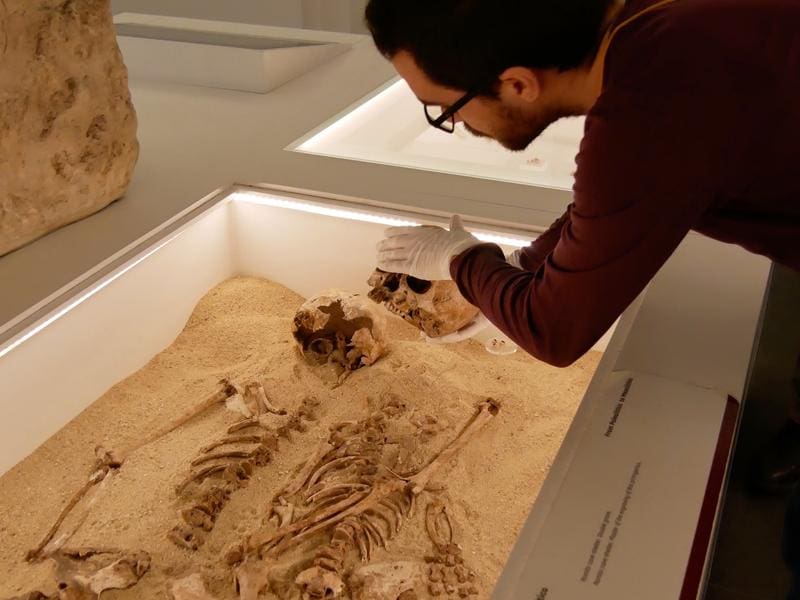
The starting point was the double grave discovered in 1963 in the Grotta del Romito in Calabria. The two individuals – “Romito 1” (adult woman, approx. 145 cm) and “Romito 2” (adolescents or young adults, approx. 110 cm) – were buried in an embrace. Romito 2 had severely shortened arms and legs, which had been the subject of speculation about a growth disorder for decades. Romito 1 was also smaller than usual for the Late Paleolithic era. Sex, degree of kinship and possible common cause of the dwarfism remained unclear for a long time.
The team extracted DNA from the temporal bone of both skeletons – a region where genetic material is particularly well preserved. The analyses showed that both people were female and first-degree relatives, most likely mother and daughter. In Romito 2, two pathogenic variants were detected in the NPR2 gene, which plays a key role in the length growth of bones. This biallelic mutation confirms the diagnosis of acrosomelic dysplasia of the Maroteaux type – a very rare autosomal recessive disease with severely shortened limbs and disproportionate short stature. Romito 1 carried only one altered copy of the same gene, which is consistent with a milder, heterozygous form of short stature.
“With the analysis of ancient DNA, we can now specifically search for genetic changes in prehistoric populations,” explains Ron Pinhasi from the University of Vienna, co-leader of the study. “This makes it possible to understand how far back rare genetic diseases go in human history.” Daniel Fernandes from the University of Coimbra, first author of the study, adds: “The genetic family history in this grave impressively shows how the same mutation affects a family differently.”
Despite the severe physical limitations, Romito 2 reached adolescence or adulthood. The researchers see this as an indication of long-term social care and support from the community – for example, in obtaining food and getting around in a challenging environment. Alfredo Coppa from the Sapienza University of Rome, also co-leader, emphasizes: “Their survival was only possible because the group supported them permanently.”
Adrian Daly from the University Hospital of Liège, third co-leader of the study, underlines the relevance for modern medicine: “Rare genetic diseases are not a modern phenomenon, but have accompanied humanity for thousands of years. The better we understand their history, the easier it is for us to recognize and treat them today.”
The study combines paleogenomics, clinical genetics and physical anthropology and includes partners from Italy, Portugal, Belgium and Austria. It marks a milestone in the application of modern genetic methods to archaeological finds.
Original Paper:
A 12,000-Year-Old Case of NPR2-Related Acromesomelic Dysplasia | New England Journal of Medicine
Editor: X-Press Journalistenbüro GbR
Gender Notice. The personal designations used in this text always refer equally to female, male and diverse persons. Double/triple naming and gendered designations are used for better readability. ected.
Most read
 First female dean in 549 years: Professor Sara Y. Brucker heads the Faculty of Medicine in Tübingen For the first time in its almost 550-year history, the Faculty of Medicine at the University of Tübi...
- New S3 guideline: ASA as an option for thrombosis prophylaxis in hip and knee surgery The updated S3 guideline for the prophylaxis of venous thromboembolism (VTE) recommends acetylsalicy...
- New MRI methods for the early detection of Parkinson’s disease: Campus Lübeck is looking for study participants Researchers at the University Medical Center Schleswig-Holstein (UKSH) and the Universities of Lübec...