
New markers could detect Alzheimer’s risk at an early stage
According to a new study from the Mark and Mary Stevens Neuroimaging and Informatics Institute (Stevens INI) at USC’s Keck School of Medicine, subtle changes in blood flow through the brain and in oxygen utilization by brain tissue may be closely related to Alzheimer’s risk.
In a study published in Alzheimer’s and Dementia: The Journal of the Alzheimer’s Association , researchers at Stevens INI found that non-invasive measurements of cerebral blood flow and oxygenation were associated with characteristic changes in the brains of older adults with and without cognitive impairment, including amyloid deposits and amyloid deposition. that noninvasive measurements of blood flow and oxygen supply to the brain are associated with characteristic changes in the brains of older adults with and without cognitive impairment, including amyloid deposits and a reduced hippocampus, an important region for memory. The results suggest that vascular health of the brain may play an important role in an early stage of the disease and could help identify at-risk individuals before significant symptoms appear.
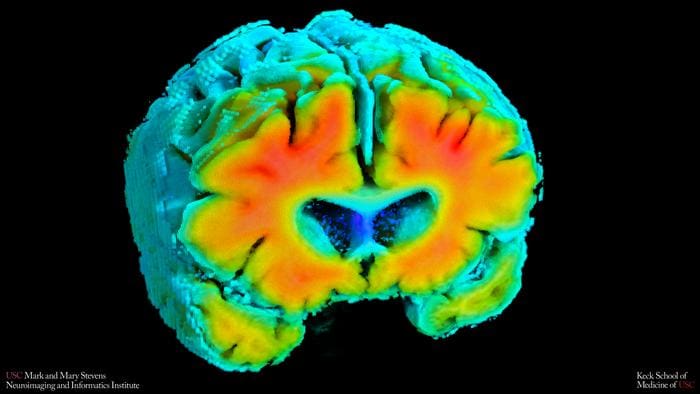
Credits:
Image/Stevens INI
“Amyloid and tau are often thought to be the main causes of Alzheimer’s, but blood flow and oxygenation are also critical,” said Amaryllis A. Tsiknia, lead author of the study and a doctoral student at USC. “Our results show that when the brain’s vascular system functions more like in healthy older people, we also observe brain features associated with better cognitive health.”
The research team used two non-invasive instruments that can be used while a person is resting calmly. Transcranial Doppler ultrasound measures how fast blood moves through the large cerebral arteries, while near-infrared spectroscopy measures how well oxygen reaches brain tissue near the surface of the cerebral cortex. Using advanced mathematical models, these signals were then aggregated into indicators that reflect how well the brain adjusts blood flow and oxygenation in response to natural changes in blood pressure and carbon dioxide levels.
Higher levels of these indicators, meaning that blood vessels in the brain behaved more like those of cognitively healthy adults, were associated with lower levels of amyloid plaques and greater hippocampal volume. Both features of the brain are associated with a lower risk of Alzheimer’s.
“These vascular measurements capture something significant about brain health,” said Meredith N. Braskie, PhD, senior author of the study and assistant professor of neurology at the Keck School of Medicine. “They appear to be consistent with the results of MRI and PET scans, which are often used to study Alzheimer’s disease, and provide important information about how vascular health and standard measures of Alzheimer’s risk in the brain might be related.”
The study also found that participants with mild cognitive impairment or dementia had worse vascular indicators than cognitively normal adults, confirming the assumption that declining cerebrovascular function is part of Alzheimer’s disease progression.
“These findings add to the growing body of evidence that Alzheimer’s incorporates important vascular factors in addition to classical neurodegenerative changes,” said Arthur W. Toga, PhD, director of Stevens INI. “Understanding how blood flow and oxygen regulation interact with amyloid and brain structure opens up new possibilities for early detection and possibly prevention.”
The techniques used are less expensive than MRI and PET scans, and because they do not require injections, radiation, or active patient involvement, they can be particularly useful for large-scale screenings or for people who cannot tolerate more challenging imaging techniques.
Original Paper:
Most read
 AMBOSS launches online training course on laboratory diagnostics with DGKL expertise AMBOSS has launched a new online training course on the 1x1 of laboratory diagnostics. The course te...
- Interview: KKH CEO Dr. Wolfgang Matz on billing fraud, AI and the future of statutory health insurance In an interview with MedLabPortal , Dr. Wolfgang Matz, Chairman of the Board of Directors of KKH Kau...
- UKE study: No effects eight months after cannabis legalization Researchers at the University Medical Center Hamburg-Eppendorf have investigated the short-term effe...