New hair root test determines individual internal clock
A research team at Charité – Universitätsmedizin Berlin has developed a test that can be used to determine a person’s chronotype based on just a few hair roots. The method is intended to create the basis for circadian medicine that aligns therapies more closely with the individual biorhythm.
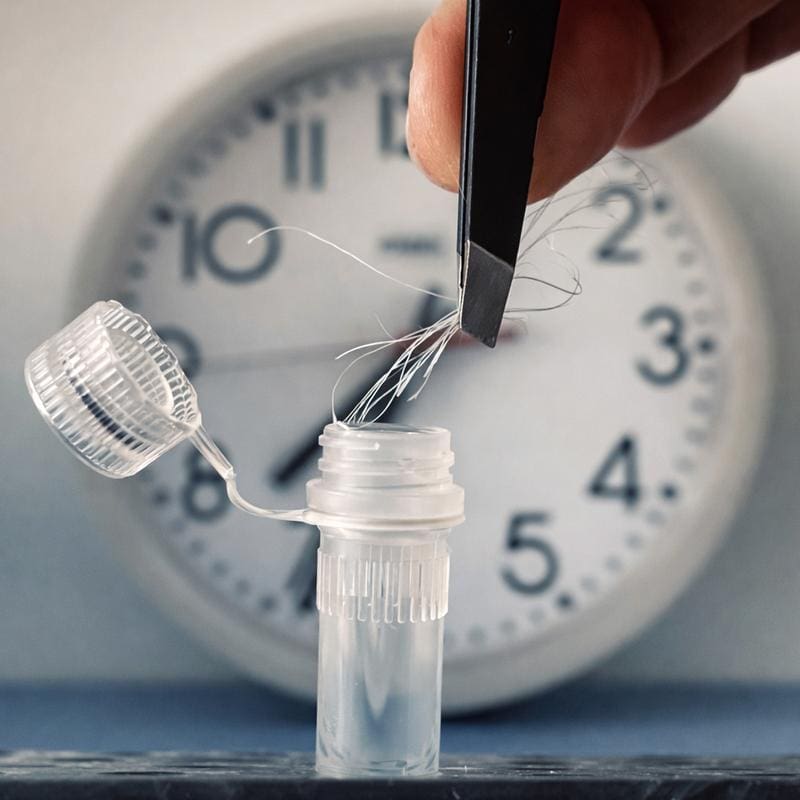
The so-called HairTime test analyzes the activity of 17 genes in the cells of the hair roots. With the help of machine learning, it is possible to calculate at what point in the circadian rhythm a person is. A single sample is sufficient – in contrast to the previous standard method, which measures melatonin in saliva over several hours under low light and can only be carried out in the laboratory.
In a study with more than 4000 participants who sent in hair samples from home, the new test proved to be similarly reliable as the previous method, but is much easier to use. The results have now been published in the journal “Proceedings of the National Academy of Sciences” (PNAS).
The evaluation of the large sample confirmed in biological measurements what surveys had already indicated: The biorhythm changes with age – people in their mid-20s go to sleep on average about an hour later than people over 50. In addition, there was a small gender difference: women’s internal clocks run on average six minutes earlier than men’s. The influence of lifestyle turned out to be stronger than expected. In employed people, the inner clock is active about half an hour earlier than in non-employed people.
The biorhythm affects not only sleep, but also metabolism and the effect of medication. For example, certain cancer therapies can be effective differently depending on the time of day because the immune system follows a rhythm of about 24 hours. The aim of circadian medicine is to systematically include this individual rhythm in diagnostics and treatment in the future.
At Charité and the University of Lübeck, a Collaborative Research Center is working to advance this field under the direction of Prof. Achim Kramer, head of the Chronobiology Department. In the future, the new test will be able to be used in routine laboratories, for example for sleep consultations or the diagnosis of sleep rhythm disorders. It could also be used to check time-adapted therapies.
BodyClock Technologies GmbH was founded as a spin-off of the Charité to market the test. Parts of the study were carried out as part of the Collaborative Research Centre “Foundations of Circadian Medicine” (TRR 418), which is funded by the German Research Foundation.
Original Paper:
Maier B et al. HairTime: A noninvasive assay for estimating circadian phase from a single hair sample. PNAS 2026 Mar 25. doi: 10.1073/pnas.2514928123
Editor: X-Press Journalistenbüro GbR
Gender Notice. The personal designations used in this text always refer equally to female, male and diverse persons. Double/triple naming and gendered designations are used for better readability. ected.
Most read
 Miraculous fitness probiotic: Roseburia inulinivorans massively improves muscle strength Researchers from the University of Granada, the University of Almería and the Leiden University Medi...
- The personal health check of the UMG laboratory: The detectives of blood The Personal Health Check of the UMG Laboratory (Interdisciplinary Laboratory of the University Medi...
- ASKED: “The new GOÄ is a far greater danger than some people realize” The new fee schedule for doctors (GOÄ) provides for significant cuts for laboratory medicine. DGKL b...