Munich researchers decipher resistance of tumors to CAR-T cells
A research team at the Technical University of Munich (TUM) has discovered a central mechanism that explains why many solid tumors do not respond adequately to CAR-T cell therapies. The innate cellular alarm system of the tumor cells, which normally fights off viral infections, plays a crucial role in the sensitivity to the immune attack.
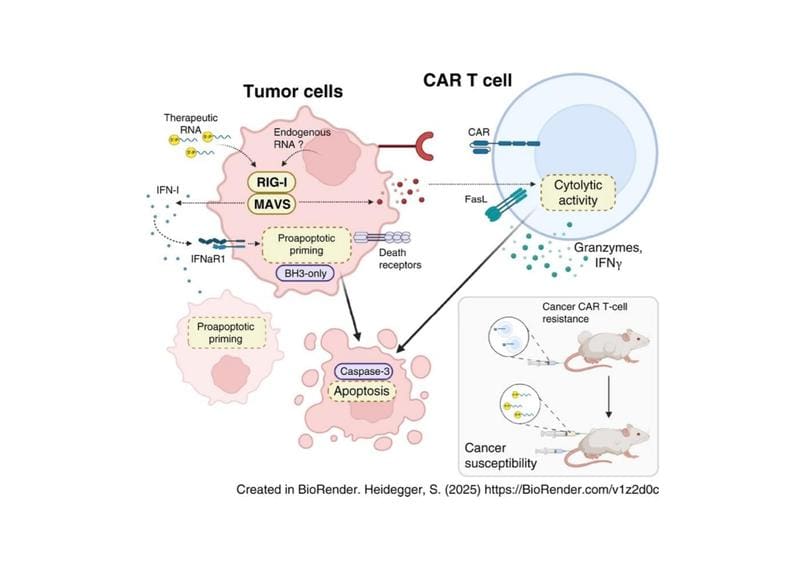
The scientists led by Dr. Nadia El Khawanky, Dr. Simon Heidegger and Dr. Nardine Soliman from the Medical Clinic and Polyclinic III of the TUM Hospital showed that the sensor protein RIG-I (Retinoic acid-inducible gene I) is of great importance for the success of the therapy. If RIG-I signaling in tumor cells is switched off, they become significantly more resistant to CAR-T cells. Conversely, the targeted activation of RIG-I increases the sensitivity of cancer cells and promotes their programmed cell death.
CAR-T cells are genetically modified immune cells that specifically recognize and destroy cancer cells. They have already achieved great success in blood cancers. In solid tumors, however, they often fail because the tumor cells can actively fend off the attack. The immunosuppressive tumor microenvironment and intrinsic resistance mechanisms of the cancer cells themselves are considered to be the main causes.
In preclinical experiments with murine tumor models, the researchers activated RIG-I with a synthetic RNA molecule that simulates a viral infection. This significantly increased the effect of the CAR-T cells – even in tumor areas that were not directly treated. The activated tumor cells also released signals that made neighboring cancer cells more receptive to the immune attack.
The results suggest that existing CAR-T cell therapies could be used more effectively against solid tumors by combining them with substances that stimulate the cellular alarm system. The activity of the nucleic acid receptors could also serve as a biomarker to identify suitable patients in advance.
The project was funded by the Wilhelm Sander Foundation with 146,000 euros. The foundation supports medical research, especially in the field of cancer control.
Original Papers:
1) Nardine Soliman, Tatiana Nedelko, Giada Mandracci, Stefan Enssle, Vincent Grass, Julius C. Fischer, Florian Bassermann, Hendrik Poeck, Sebastian Kobold, Nadia El Khawanky, Simon Heidegger; Targeting Intracellular Innate RNA-Sensing Systems Overcomes Resistance to CAR T-cell Therapy in Solid Tu-mors. Cancer Res 15 July 2025; 85 (14): 2679–2693. https://doi.org/10.1158/0008-5472.CAN-24-3425
2) Mandracci, G.; Soliman, N.; El Khawanky, N. Overcoming Immune Therapy Re-sistance in Cancer Through Innate Immune Reprogramming. Int. J. Mol. Sci. 2025, 26, 9554. https://doi.org/10.3390/ijms26199554
Editor: X-Press Journalistenbüro GbR
Gender Notice. The personal designations used in this text always refer equally to female, male and diverse persons. Double/triple naming and gendered designations are used for better readability. ected.
Most read
 Miraculous fitness probiotic: Roseburia inulinivorans massively improves muscle strength Researchers from the University of Granada, the University of Almería and the Leiden University Medi...
- DGKL board member Jan Wolter calls for comprehensive health tax instead of pure sugar tax Jan Wolter, chairman of the German Society for Clinical Chemistry and Laboratory Medicine (DGKL), ha...
- ASKED: “The new GOÄ is a far greater danger than some people realize” The new fee schedule for doctors (GOÄ) provides for significant cuts for laboratory medicine. DGKL b...