MHH researchers discover “molecular memory” in kidney transplants
A research team at the Hannover Medical School (MHH) led by Prof. Dr. Christian Hinze has identified new cellular markers that provide information about the long-term recovery capacity of a kidney transplant after acute rejection. The specific cell states discovered in the tubule cells of the kidney form a kind of molecular memory of the rejection episode and in some cases persist even after successful therapy. They occur particularly frequently if the graft later shows a high risk of failure. The results were published in Nature Communications.
Acute T-cell-mediated rejection continues to be one of the main causes of long-term kidney transplant failure. In this process, immune cells recognize the foreign organ, migrate, trigger inflammation and damage the tissue. If the reaction is not suppressed in time, the graft function gradually decreases.
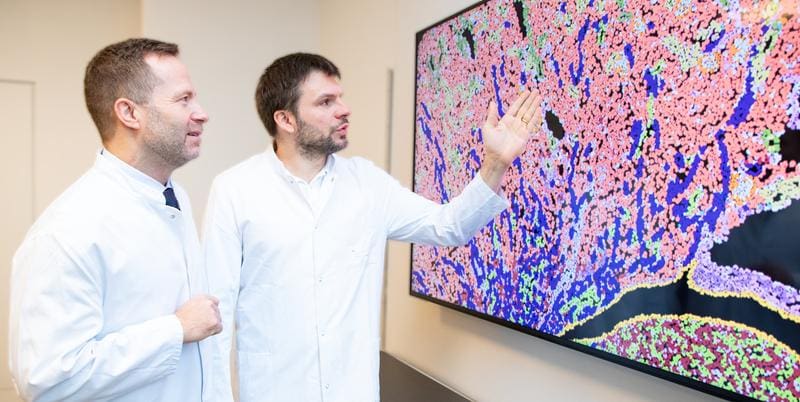
Prof. Hinze’s team, together with partners from Charité Berlin and the Alberta Transplant Applied Genomics Centre in Canada, investigated the changes in transplant tissue during and after rejection. The focus was not only on the immigrating immune cells, but above all on the reaction of the tubule cells – those cells of the fine tube system that are responsible for essential transport processes. These cells develop conspicuous patterns under stress and during repair, which differ significantly from healthy cells.
“Some of these cell states do not disappear completely even after successful treatment of rejection,” explains Prof. Hinze, senior physician at the MHH Clinic for Kidney and Hypertension Diseases and responsible for the aftercare of kidney transplant patients. “They form a molecular memory and serve as an indicator of how well the kidney is really recovering. Especially with a high proportion of such cells in the biopsy, there is an increased risk of later graft failure.”
In large patient cohorts, it was confirmed that a high proportion of these persistent cell states is a warning signal. The findings open up the possibility for doctors to assess the individual risk after rejection more precisely and to design follow-up care in a more targeted manner – for example through therapy adaptation or closer monitoring.
“The new markers could help us to identify patients who are at particularly high risk,” says Prof. Dr. Kai Schmidt-Ott, Director of the MHH Clinic for Nephrology and co-author of the study. “In the long term, there is hope to modulate these cellular programs therapeutically – but this must be tested in future studies.”
The researchers combined experimental models, single-cell analyses, spatial gene expression data and extensive biopsy cohorts to obtain a detailed picture of the origin, distribution and prognostic significance of these cell states. For the MHH as one of the leading European transplant centres, the results mark a further step towards more precise and future-oriented transplantation medicine.
Original Paper:
Editor: X-Press Journalistenbüro GbR
Gender Notice. The personal designations used in this text always refer equally to female, male and diverse persons. Double/triple naming and gendered designations are used for better readability. ected.
Most read
 First female dean in 549 years: Professor Sara Y. Brucker heads the Faculty of Medicine in Tübingen For the first time in its almost 550-year history, the Faculty of Medicine at the University of Tübi...
- New S3 guideline: ASA as an option for thrombosis prophylaxis in hip and knee surgery The updated S3 guideline for the prophylaxis of venous thromboembolism (VTE) recommends acetylsalicy...
- New MRI methods for the early detection of Parkinson’s disease: Campus Lübeck is looking for study participants Researchers at the University Medical Center Schleswig-Holstein (UKSH) and the Universities of Lübec...