
Kiel researchers develop ultra-light aerohydrogels for realistic brain cell cultures
An interdisciplinary team at Kiel University (CAU), in collaboration with researchers from Harvard Medical School and the University of Oxford, has developed a novel ultralight 3D material that enables human brain cells to grow and network realistically in three dimensions. The so-called aerohydrogels are intended to advance neuroresearch and tissue engineering.
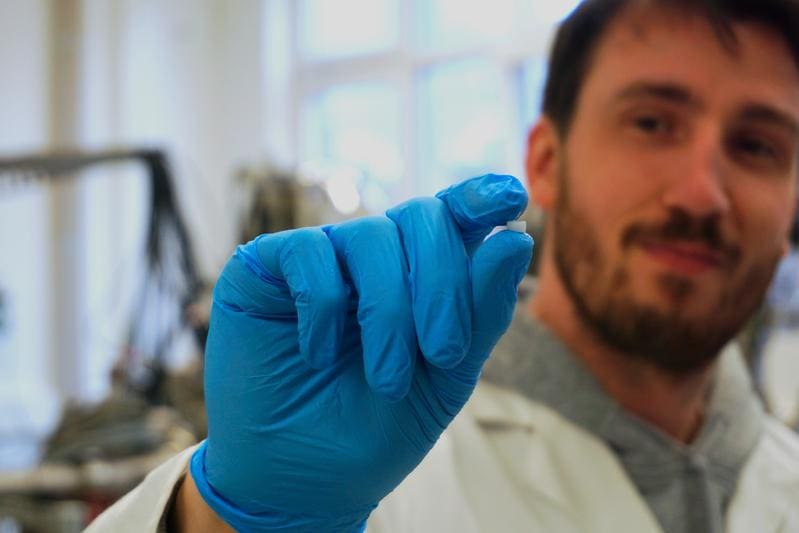
Conventional 3D cell cultures are often either too rigid or too unstable to authentically image the complex interactions of nerve cells, astrocytes and microglia. The new aerohydrogels consist of a hollow-fibre hydrogel framework produced on the basis of tetrapodal zinc oxide crystals (t-ZnO). After the formation of a cross-linked 3D skeleton, a wafer-thin coating is carried out by means of initiated chemical vapor deposition (iCVD) before the zinc oxide is removed. What remains is an extremely light, porous hydrogel framework that is mechanically adaptable and allows nutrients and signaling substances to diffuse freely.
Compared to conventional 3D scaffolds, the aerohydrogels are characterized by high long-term stability. Pore size, mechanical stiffness and surface chemistry can be varied independently of each other and specifically adapted to different tissue types – from soft brain tissue to firmer heart tissue.
The Kiel researchers tested the material with human astrocytes and microglia. In co-cultures, the cells showed a differentiated response to pro-inflammatory stimuli such as lipopolysaccharide (LPS). Microglia mitigated certain inflammatory reactions in the presence of astrocytes – an effect that indicates functioning cell communication via the scaffold, even without direct cell contact. Such interactions can only be represented to a limited extent in 2D or conventional 3D cultures.
The results were published in the journal “Chem & Bio Engineering”. The iCVD technology used is already being used by the Kiel-based start-up conformally, which was founded by participating scientists and plans to offer the scaffolds commercially in the future.
According to the researchers, the aerohydrogels open up new possibilities for investigating neuronal processes, cell communication and inflammatory reactions under more physiological conditions. In the long term, they could contribute to the model replication of tissue in the laboratory and thus help to reduce animal experiments in basic research and in the development of new therapies.
Original Paper:
Torge Hartig et al. (2026): “3D Aerohydrogel Scaffolds for Brain Tissue Engineering and In Vitro Neuroscience”, Chem. & Bio. Eng., ASAP, DOI: 10.1021/cbe.5c00104
Editor: X-Press Journalistenbüro GbR
Gender Notice. The personal designations used in this text always refer equally to female, male and diverse persons. Double/triple naming and gendered designations are used for better readability. ected.
Most read
 First female dean in 549 years: Professor Sara Y. Brucker heads the Faculty of Medicine in Tübingen For the first time in its almost 550-year history, the Faculty of Medicine at the University of Tübi...
- Interview: KKH CEO Dr. Wolfgang Matz on billing fraud, AI and the future of statutory health insurance In an interview with MedLabPortal , Dr. Wolfgang Matz, Chairman of the Board of Directors of KKH Kau...
- Psychotherapy: National Association of Statutory Health Insurance Funds plans blanket fee reduction of ten percent The professional association unith e.V. warns of an imminent blanket reduction of fees for psychothe...