Implant supplies the brain with medication
Researchers at the Technical University of Denmark (DTU), the University of Copenhagen, University College London and other institutions have developed a novel, needle-thin brain implant. The so-called microfluidic axialtrode (mAxialtrode) combines the recording of neuronal signals, targeted drug delivery and optical stimulation over the entire length of the implant in a single flexible implant.
The results of the development were published in the journal Advanced Science. The implant was primarily designed for basic research on the brain. It should help to better understand how signals travel across different brain layers – for example, in epilepsy, memory processes or decision-making. In the long term, the scientists see potential for the treatment of neurological diseases, for example through precise drug delivery combined with electrical or light-based stimulation of targeted brain regions.
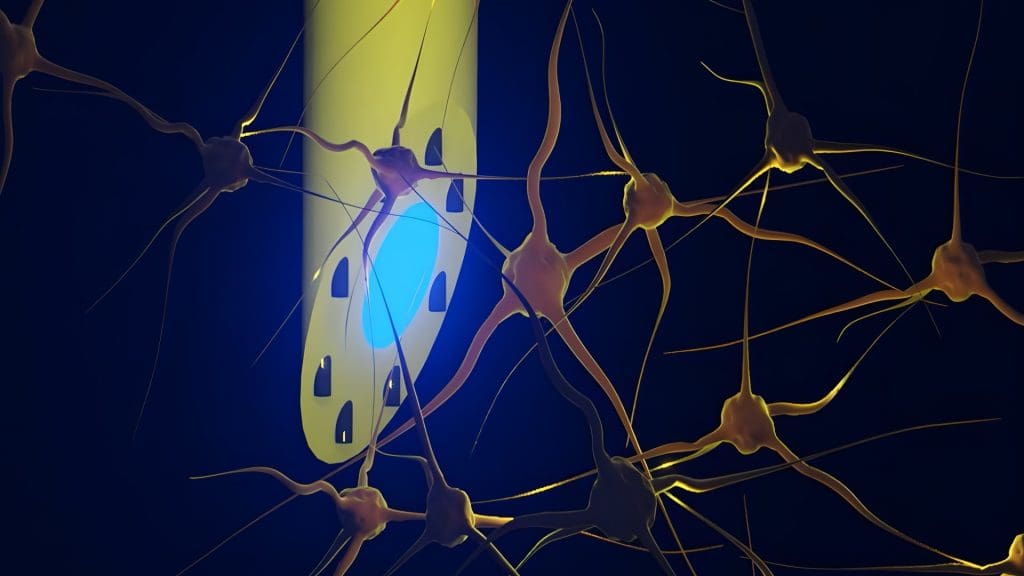
Postdoc Kunyang Sui, who developed the concept together with Associate Professor Christos Markos, emphasizes the advantage of multifunctionality: Multiple functions in one implant make brain research less invasive and more precise. Unlike traditional hard silicon implants, the mAxialtrode is made of soft, plastic-like optical fibers with a specially angled end. This makes it smaller and causes less tissue damage when inserted.
Conventional optical fibers with a flat end only act at the tip (distal end) and therefore only allow stimulation or measurement in a single brain layer. However, many important brain functions rely on interactions between multiple layers and deeper regions.
The technology has been tested not only in the laboratory, but also in vivo on mice. The implant was inserted into the brain and connected to light sources, measuring devices and small pumps for fluids. The experiments showed that nerve cells could be stimulated with blue and red light, electrical activity could be measured simultaneously from superficial and deeper layers (such as the cerebral cortex and hippocampus), and substances could be injected at intervals of up to almost three millimeters – all via a single light fiber that the animals carried without any discernible impairment.
The researchers have filed a patent application for the underlying technology and are currently clarifying possibilities for clinical trials on patients. Before it can be used in human medicine, extensive further tests, further developments and approval procedures are required.
Original Paper:
Editor: X-Press Journalistenbüro GbR
Gender Notice. The personal designations used in this text always refer equally to female, male and diverse persons. Double/triple naming and gendered designations are used for better readability. ected.
Most read
 Miraculous fitness probiotic: Roseburia inulinivorans massively improves muscle strength Researchers from the University of Granada, the University of Almería and the Leiden University Medi...
- The personal health check of the UMG laboratory: The detectives of blood The Personal Health Check of the UMG Laboratory (Interdisciplinary Laboratory of the University Medi...
- ASKED: “The new GOÄ is a far greater danger than some people realize” The new fee schedule for doctors (GOÄ) provides for significant cuts for laboratory medicine. DGKL b...