
HZB commissions state-of-the-art reactor platform for thin-film catalysts
Helmholtz-Zentrum Berlin (HZB) has commissioned the largest single investment of the project to date as part of the large-scale CatLab project. The test facility built by the Berlin-based company ILS with eight parallel chemical reactors has now been delivered and installed at the Adlershof site. The investment volume is over 2.5 million euros.
The plant is designed to test thin-film and powder catalysts under realistic process conditions. It allows temperatures from room temperature to 780 °C, pressures up to 50 bar as well as variable flow rates and residence times – both in continuous and batch operation. This allows numerous reactions central to the energy transition to be investigated.
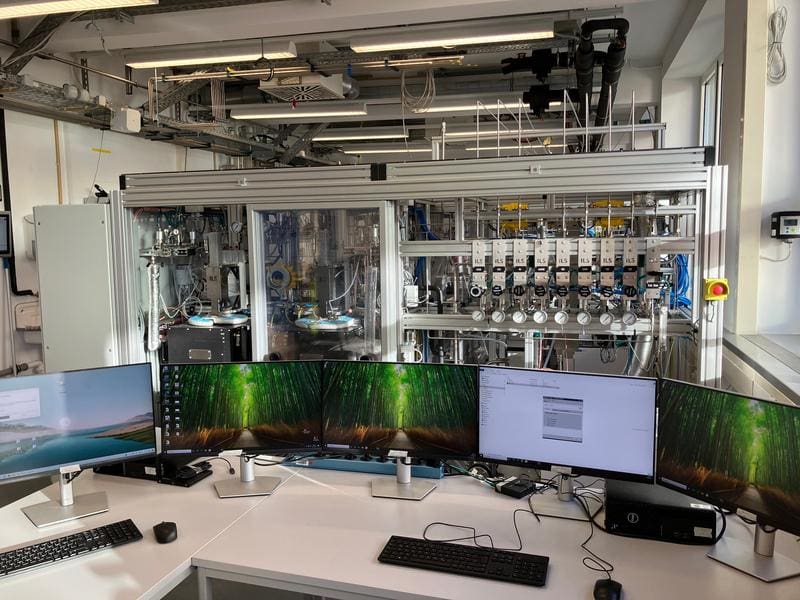
These include the conversion of carbon dioxide to methanol, the dry reforming of methane into synthesis gas, and Fischer-Tropsch synthesis for the production of synthetic fuels. The reactors are used for the rapid comparison of catalyst candidates, the determination of reaction kinetic data and, above all, the evaluation of long-term stability, which is crucial for later industrial use.
Project managers at HZB describe the plant as a future core component in the development of scalable thin-film catalysts. It is intended not only to advance the CatLab project itself, but also to support the center’s own basic research as well as ongoing and planned cooperation projects such as CARE-O-SENE, Greenquest and other newly launched initiatives.
Overall, CatLab aims to establish industrial-grade manufacturing processes for high-efficiency thin-film catalysts in order to accelerate the transition to a climate-neutral chemical and energy industry. The new reactor platform creates crucial experimental conditions for this.
Editor: X-Press Journalistenbüro GbR
Gender Notice. The personal designations used in this text always refer equally to female, male and diverse persons. Double/triple naming and gendered designations are used for better readability. ected.
Most read
 First female dean in 549 years: Professor Sara Y. Brucker heads the Faculty of Medicine in Tübingen For the first time in its almost 550-year history, the Faculty of Medicine at the University of Tübi...
- Psychotherapy: National Association of Statutory Health Insurance Funds plans blanket fee reduction of ten percent The professional association unith e.V. warns of an imminent blanket reduction of fees for psychothe...
- Lifesaver laboratory medicine: “As a rule, a result should be available after 60 minutes at the latest for emergencies.” 11.2 is the day of the emergency call - but for laboratory medicine it is only one of 365 days on wh...