
Groundbreaking urine test could revolutionize bladder cancer diagnosis
Researchers have found that analyzing specific patterns of cell-free DNA (cfDNA) fragmentation in a simple urine sample enables effective diagnosis and staging of bladder cancer, providing a much-needed alternative to invasive procedures such as cystoscopies. This novel approach, detailed in a new study in The Journal of Molecular Diagnostics , could reduce the need for frequent cystoscopies, reduce healthcare costs, and improve comfort and outcomes for patients.
Bladder cancer continues to be a major clinical challenge, as it is one of the most common and deadly urological cancers with a high recurrence rate. However, his diagnosis still relies heavily on invasive and costly procedures such as cystoscopy (inserting a thin, tube-like instrument through the urethra) or cytology, a non-invasive test that can identify tumor cells in the urine but has limited sensitivity.
The researchers were motivated to find a simpler and more convenient method of detecting and monitoring bladder cancer. They analyzed urine samples from 156 patients with bladder cancer and 79 matching controls, and used real-time PCR to measure the concentration and integrity (long-short size distribution) of cfDNA fragments from five genes (ACTB, AR, MYC, BCAS1 , and STOX1).
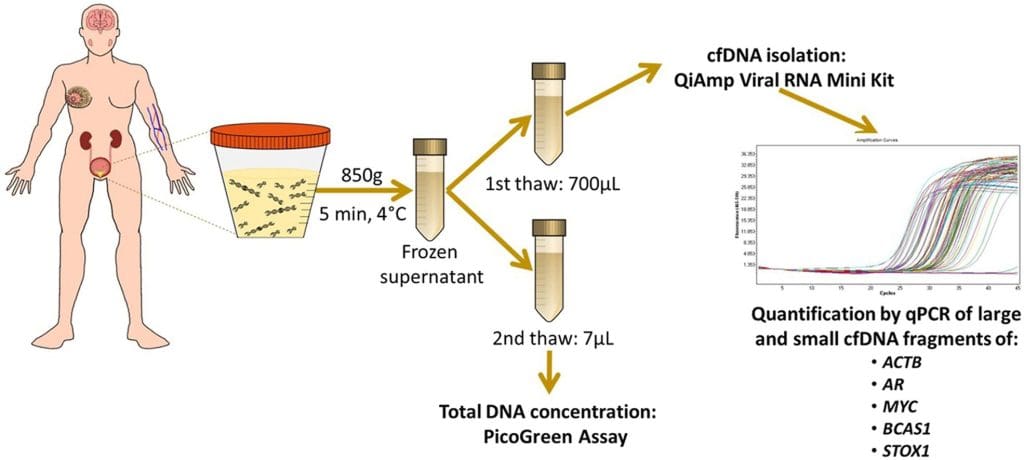
“Our key finding was that the small fragment of the MYC gene could be a valuable tool for diagnosing bladder cancer, as it had excellent specificity (97%) and predictive power (88%) for the identification of muscle-invasive bladder cancer,” explains lead researcher Pilar Medina, PhD, Research Group on Hemostasis, Thrombosis, Atherosclerosis, and Vascular Biology, Hospital La Fe Health Research Institute (IIS La Fe), Valencia, Spain.
MYC produces a transcription factor that is crucial for regulating cell growth, proliferation, and cell metabolism.
In addition, the researchers found that the ratio of large to small fragments of the house genome ACTB and the small fragment of the AR gene increased with the severity of the disease, suggesting that these could be reliable biomarkers for staging. The integrity of these genes could be useful for detecting a relapse of bladder cancer.
Editor: X-Press Journalistenbüro GbR
Gender Notice. The personal designations used in this text always refer equally to female, male and diverse persons. Double/triple naming and gendered designations are used for better readability. ected.
Most read
 First female dean in 549 years: Professor Sara Y. Brucker heads the Faculty of Medicine in Tübingen For the first time in its almost 550-year history, the Faculty of Medicine at the University of Tübi...
- Interview: KKH CEO Dr. Wolfgang Matz on billing fraud, AI and the future of statutory health insurance In an interview with MedLabPortal , Dr. Wolfgang Matz, Chairman of the Board of Directors of KKH Kau...
- Lifesaver laboratory medicine: “As a rule, a result should be available after 60 minutes at the latest for emergencies.” 11.2 is the day of the emergency call - but for laboratory medicine it is only one of 365 days on wh...