
Germany lags behind Western Europe in terms of avoidable mortality
Germany has made progress in reducing avoidable deaths in recent decades, but has not been able to reduce the gap with many regions of Western Europe. Compared to particularly successful countries such as Switzerland, the gap has even widened. This is shown by a new study by the Federal Institute for Population Research (BiB) and the Universities of Groningen and Oldenburg.
Avoidable mortality includes deaths before the age of 75 that could have been prevented by timely medical treatment or preventive measures. The researchers evaluated data from 581 European regions in the period from 2002 to 2019. The results have been published in the “European Journal of Population”.
Many German regions continue to have significantly higher rates of avoidable mortality than the Western European average. The northeast of Germany, including northern Thuringia, eastern Lower Saxony and large parts of Saxony-Anhalt, Brandenburg and Mecklenburg-Western Pomerania, are particularly affected.
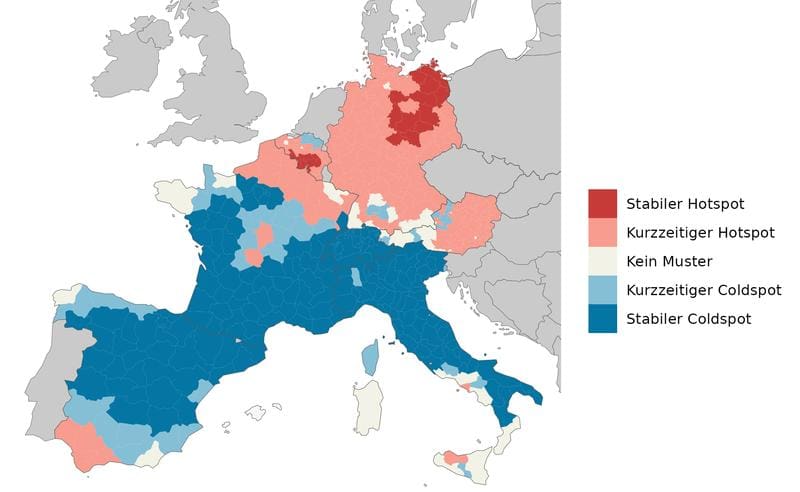
In Western Europe, Switzerland and large parts of Italy, France and Spain form stable “cold spots” with particularly low avoidable mortality. Within Germany, only the region between Tübingen and Ulm belonged to these favourable areas at times. Hotspots with high rates can be found outside Germany mainly in Belgium, in the north and northeast of France, in the east of Austria and in the southwest of Spain.
The scientists attribute the regional differences to two main factors: the different efficiency of early detection and treatment, and the health-related behavior of the population. In Germany, there is still considerable catch-up potential, especially in prevention – especially with regard to the risk factors smoking, excessive alcohol consumption, unhealthy diet and lack of exercise.
The study makes it clear that health inequalities in Europe cannot be explained by national health systems alone. Socio-economic factors such as income, education and employment prospects also play a decisive role. The researchers advocate aligning health policy measures more closely with regional needs in the future.
The evaluation only takes into account the period up to 2019 in order to rule out distortions caused by the corona pandemic.
Original paper:
Editor: X-Press Journalistenbüro GbR
Gender Notice. The personal designations used in this text always refer equally to female, male and diverse persons. Double/triple naming and gendered designations are used for better readability. ected.
Most read
 Miraculous fitness probiotic: Roseburia inulinivorans massively improves muscle strength Researchers from the University of Granada, the University of Almería and the Leiden University Medi...
- DGKL board member Jan Wolter calls for comprehensive health tax instead of pure sugar tax Jan Wolter, chairman of the German Society for Clinical Chemistry and Laboratory Medicine (DGKL), ha...
- ASKED: “The new GOÄ is a far greater danger than some people realize” The new fee schedule for doctors (GOÄ) provides for significant cuts for laboratory medicine. DGKL b...