First cartilage transplant from Würzburg on the way to implantation
At the University Hospital Würzburg (UKW), a cartilage transplant from a patient’s nose for the treatment of knee osteoarthritis was produced for the first time as part of the European ENCANTO study. The transplant, which will be implanted within 24 hours in one of eleven participating clinics in Europe, marks a milestone in regenerative medicine. The aim of the study is to alleviate pain in patella-femoral osteoarthritis, improve joint mobility and establish joint-preserving therapies to avoid joint prostheses.
The ENCANTO study, which stands for “Engineered Cartilage from Nose for the Treatment of Osteoarthritis”, involves the recruitment of 150 patients at various European centers. In Würzburg, the transplant is produced in the GMP manufacturing facility under the direction of Prof. Matthias Eyrich. Cartilage cells are removed from the patients’ nasal septum, multiplied in the laboratory and grown into new cartilage tissue (N-TEC) on a collagen matrix. This process takes about four weeks and is carried out under strict quality specifications of “Good Manufacturing Practice” (GMP).
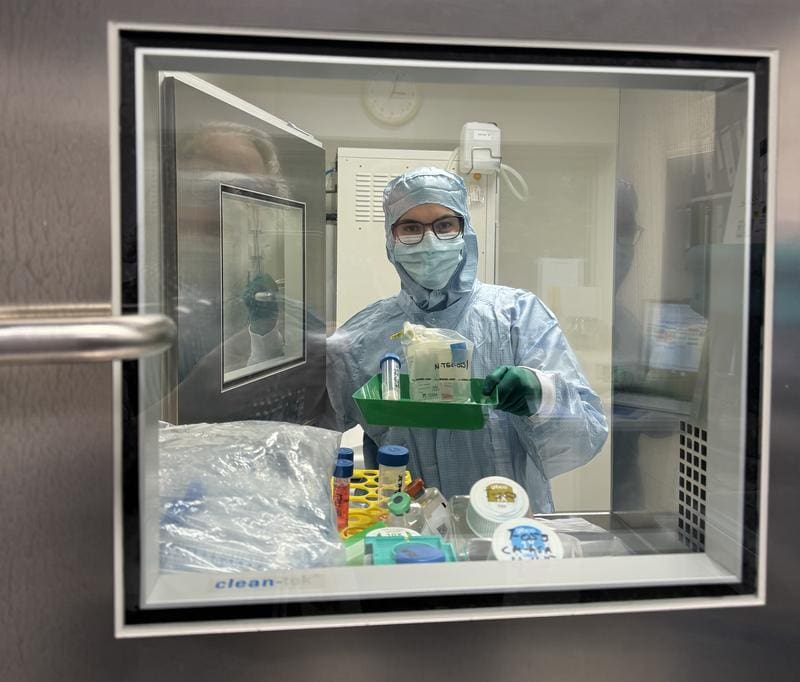
The quality control of the graft, which bears the name “Paula”, was carried out in several steps. First, sterility was confirmed by microbiological monitoring at the Institute of Hygiene and Microbiology. Subsequently, a pathologist at the Institute of Pathology assessed the viability of the cells, which were classified as alive and functional. At the Chair of Functional Materials in Medicine and Dentistry, tissue architecture and cell morphology were analyzed. A special staining process showed a high concentration of proteoglycans, which are crucial for the elasticity and stability of the cartilage. The high Modified Bern score finally confirmed the suitability of the graft for implantation.
The close cooperation between the participating departments of the UKW, including Pathology, Hygiene and the GMP Stem Cell Transplant Center, was decisive for the success. The working group led by PD Dr. Oliver Pullig, which cooperates with a team from Basel, emphasised the importance of local and international networking. The transplant is a product “made in Würzburg” and underlines the innovative strength of the hospital.
The patient, whose identity remains anonymous, does not know whether he will receive the cartilage graft or a control matrix without cartilage cells, as the study is blinded. With the release of the transplant, the transport to the clinic begins, where the implantation takes place. The ENCANTO study could set new standards in the treatment of osteoarthritis in the long term and offer patients an alternative to invasive prostheses.
Editor: X-Press Journalistenbüro GbR
Gender Notice. The personal designations used in this text always refer equally to female, male and diverse persons. Double/triple naming and gendered designations are used for better readability. ected.
Most read
 Miraculous fitness probiotic: Roseburia inulinivorans massively improves muscle strength Researchers from the University of Granada, the University of Almería and the Leiden University Medi...
- The personal health check of the UMG laboratory: The detectives of blood The Personal Health Check of the UMG Laboratory (Interdisciplinary Laboratory of the University Medi...
- ASKED: “The new GOÄ is a far greater danger than some people realize” The new fee schedule for doctors (GOÄ) provides for significant cuts for laboratory medicine. DGKL b...