
ETH researchers produce elastic ear cartilage in the laboratory
Researchers at ETH Zurich, the Friedrich Miescher Institute in Basel and the Lucerne Cantonal Hospital have grown elastic ear cartilage from human cells in the laboratory, whose mechanical properties largely correspond to those of a natural ear. The artificial tissue proved to be dimensionally stable in the animal model and retained its structure and elasticity for six weeks. The results were published in the journal Advanced Functional Materials.
In the future, the procedure could offer a gentler alternative to the reconstruction of the outer ear in the case of congenital microtia or after accidents and burns. Microtia occurs in about one to four out of 10,000 children. The current standard is the use of the patient’s rib cartilage, a painful procedure that can cause scars and deformations in the chest area and usually results in a stiffer ear.
The scientists isolated starting cells from small cartilage remnants that occur during ear surgical corrections. From a piece about three millimeters in size, they first obtained around 100,000 cells, which they multiplied to several hundred million in a special nutrient solution. To prevent an undesirable transformation into scar-forming fibroblasts, they optimized growth factors and culture conditions in a targeted manner.
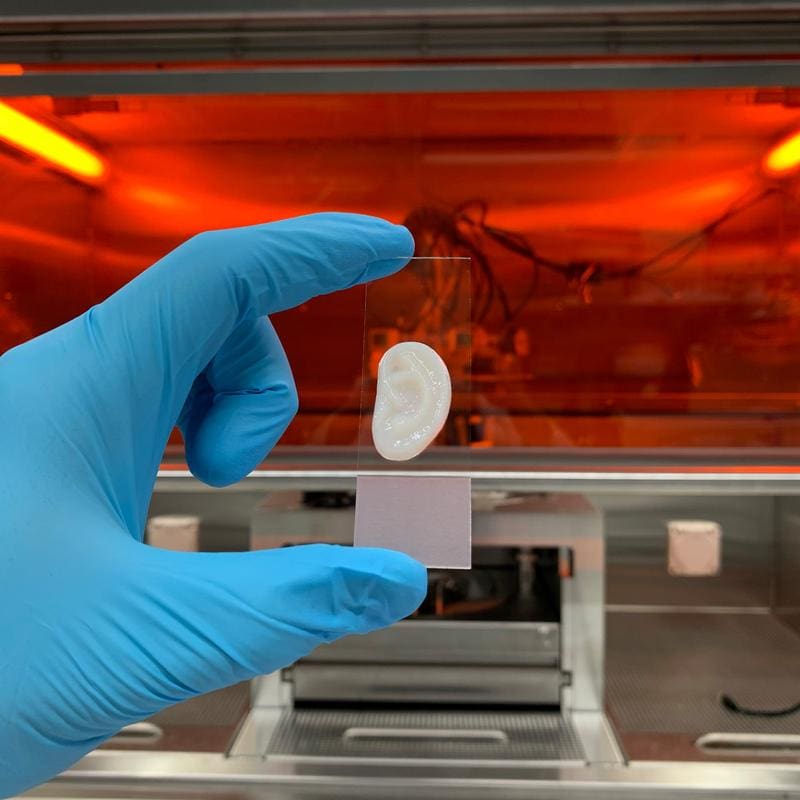
The multiplied cells were embedded in a gel-like bio-ink and shaped into ear structures with a 3D printer. After printing, the constructs matured for nine weeks in an incubator under controlled nutrient and oxygen supply to promote the formation of collagen type II, elastin and glycosaminoglycans – the crucial components for the strength, elasticity and water binding of the cartilage.
The success was based on four combined optimizations: improved cell proliferation, adapted material properties, increased cell density and precisely controlled maturation environment. After implantation under the skin of rats, the ear shape was retained for six weeks; the mechanical properties were close to the natural fabric.
The biggest remaining challenge is the elastin, which gives the ear its characteristic flexibility. Although elastin has been formed, the exact biological mechanism for its correct cross-linking and long-term stabilization is still missing. Changes in the tissue show that this component needs to be further optimized.
Worldwide, only a few teams are working on elastic ear cartilage. Each experiment lasts three to four months. The research group led by ETH Professor Marcy Zenobi-Wong has been working on the topic for over ten years. Advances in tissue engineering are rarely visible quickly.
The current work builds on previous successes, including a 3D-printed ear unveiled in 2016. If the outcome is favorable, the researchers expect a stable elastin mechanism within the next five years. After that, preclinical testing, clinical trials, and approval procedures would be required before the procedure could reach the clinic.
The study is considered an important assessment of the current situation: it shows how close the laboratory tissue is already to the natural ear and precisely identifies the remaining gaps.
Original Paper:
Fisch P, Kessler S, Ponta S, et al. Tissue engineered human elastic cartilage from primary auricular chondrocytes for ear reconstruction. Advanced Functional Materials (2026): e30253. DOI: 10.1002/adfm.202530253
Editor: X-Press Journalistenbüro GbR
Gender Notice. The personal designations used in this text always refer equally to female, male and diverse persons. Double/triple naming and gendered designations are used for better readability. ected.
Most read
 Miraculous fitness probiotic: Roseburia inulinivorans massively improves muscle strength Researchers from the University of Granada, the University of Almería and the Leiden University Medi...
- DGKL board member Jan Wolter calls for comprehensive health tax instead of pure sugar tax Jan Wolter, chairman of the German Society for Clinical Chemistry and Laboratory Medicine (DGKL), ha...
- ASKED: “The new GOÄ is a far greater danger than some people realize” The new fee schedule for doctors (GOÄ) provides for significant cuts for laboratory medicine. DGKL b...