
Elucidation of Oroya fever opens up new therapeutic options
Researchers at the University Medical Center Frankfurt have elucidated the mechanism of the deadly infectious disease Oroya fever, which is caused by the bacterium Bartonella bacilliformis. They identified two proteins responsible for destroying red blood cells and found an inhibitor that stops this process in the lab. The results could lead to a novel treatment that circumvents resistance.
Oroya fever is one of the neglected tropical diseases and has so far only occurred in high-altitude Andean valleys in South America, mainly in Peru, Ecuador and Colombia. The pathogen is transmitted by bites of sand flies of the genus Lutzomyia. The infection begins with high fever and massive destruction of red blood cells, resulting in hemolytic anemia. Without antibiotics, the disease is fatal in up to 90 percent of cases. Already 26 percent of the pathogens show resistance to the standard antibiotic ciprofloxacin, which makes treatment more difficult.
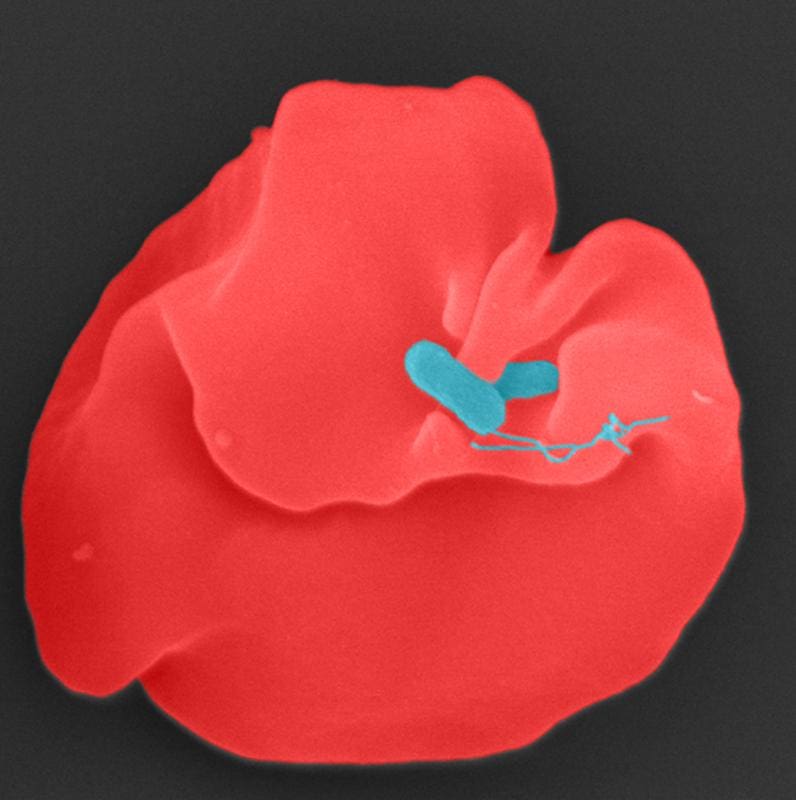
Due to its limited range, the disease has received little attention in research and drug development. However, experts warn of a spread due to climate change and increasing travel, as sand flies could expand their habitat, possibly as far as Europe.
An international team led by the director of the Institute of Medical Microbiology and Hospital Hygiene analyzed over 1700 genetic variants of the bacterium. They discovered a porin protein that enables exchange with the environment and an enzyme called alpha-beta hydrolase. Both proteins work together and cause hemolysis. Structural analyses and targeted mutations proved that the enzymatic activity of the hydrolase is crucial. This makes the enzyme a potential target for drugs.
In laboratory experiments, a phospholipase inhibitor blocked hydrolase activity and prevented the destruction of blood cells. Such a therapy could minimize resistance, as it directly attacks the disease-causing effect of the pathogen. The disease kills hundreds in South America every year, often unnoticed by the world public, and is poverty-related.
The study is based on a cooperation with the Universidad Peruana Cayetano Heredia in Lima since 2019. As part of a German-Peruvian network, researchers collected samples in endemic areas and analysed isolates. The work was funded by the LOEWE Centre DRUID in Hesse, which focuses on neglected tropical diseases. After the funding expires, the researchers are looking for new means to clarify the pathogen’s binding mechanism to blood cells, similar to related bacteria before.
Original Paper:
Editor: X-Press Journalistenbüro GbR
Gender Notice. The personal designations used in this text always refer equally to female, male and diverse persons. Double/triple naming and gendered designations are used for better readability. ected.
Most read
 Miraculous fitness probiotic: Roseburia inulinivorans massively improves muscle strength Researchers from the University of Granada, the University of Almería and the Leiden University Medi...
- The personal health check of the UMG laboratory: The detectives of blood The Personal Health Check of the UMG Laboratory (Interdisciplinary Laboratory of the University Medi...
- ASKED: “The new GOÄ is a far greater danger than some people realize” The new fee schedule for doctors (GOÄ) provides for significant cuts for laboratory medicine. DGKL b...