Electron microscopy: Espresso as an environmentally friendly alternative to uranyl acetate
Researchers at the Institute of Electron Microscopy and Nanoanalytics at the Graz University of Technology have demonstrated ordinary espresso as an effective contrast agent for biological samples under the electron microscope. The images achieve a comparable or in some cases better quality than with the highly toxic and radioactive standard agent uranyl acetate.
Uranyl acetate is traditionally used to visualize tissue structures in ultra-thin sample sections. Due to its toxicity and radioactivity, the substance is banned in some laboratories for safety reasons. The team led by Claudia Mayrhofer, Ilse Letofsky-Papst and Robert Zandonella was looking for an alternative.
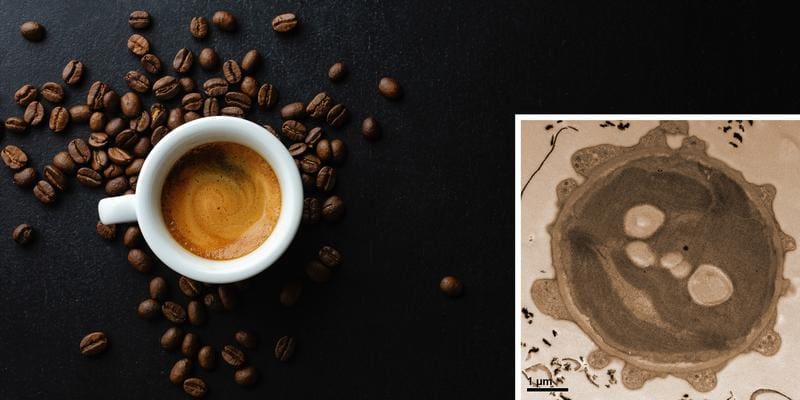
The idea came from observing dried coffee stains in cups. Initial tests showed that coffee stains biological samples and enhances contrasts. In systematic comparative experiments, the researchers treated ultra-thin sections of mitochondria under identical conditions with espresso and uranyl acetate. Image analysis software evaluated the microscope images. Espresso achieved very good contrast values, in some cases even higher than uranyl acetate.
The team sees coffee as a serious, environmentally friendly alternative. However, for widespread use in biological electron microscopy, further tests on different tissue types are required.
Original Paper:
Coffee – a ubiquitous substitute for uranyl acetate in staining of biological ultrathin sections for electron microscopy studies
Authors: Claudia Mayrhofer, Robert Zandonella, Willi Salvenmoser, Ilse Letofsky-Papst.
In: Methods (2025)
DOI: 10.1016/j.ymeth.2025.08.009
Editor: X-Press Journalistenbüro GbR
Gender Notice. The personal designations used in this text always refer equally to female, male and diverse persons. Double/triple naming and gendered designations are used for better readability. ected.
Most read
 Psychotherapy: National Association of Statutory Health Insurance Funds plans blanket fee reduction of ten percent The professional association unith e.V. warns of an imminent blanket reduction of fees for psychothe...
- Lifesaver laboratory medicine: “As a rule, a result should be available after 60 minutes at the latest for emergencies.” 11.2 is the day of the emergency call - but for laboratory medicine it is only one of 365 days on wh...
- First female dean in 549 years: Professor Sara Y. Brucker heads the Faculty of Medicine in Tübingen For the first time in its almost 550-year history, the Faculty of Medicine at the University of Tübi...