Drones and robots locate radioactive sources quickly and precisely
Researchers at the Fraunhofer Institute for Communication, Information Processing and Ergonomics FKIE are developing drones and robots that detect and locate radioactive, chemical, biological, nuclear and explosive substances (CBRNE) from a safe distance. The systems significantly reduce the risk for emergency services and the population. The technologies are regularly tested and further developed under realistic conditions at the European Robotics Hackathon (EnRicH) at the Zwentendorf nuclear power plant and at the European Land Robot Trial (ELROB).
Radioactive sources are usually invisible and cannot be detected from a distance. Examples such as the days-long search for a tiny cesium capsule in Australia in 2023 show the challenges. The threat situation has been exacerbated by hybrid attacks and destabilization measures.
On behalf of the Defence Science Institute for Protection Technologies – NBC Protection (WIS), the Sensor Data and Information Fusion department has developed a highly automated drone demonstrator. This locates radioactive sources within a few minutes with an accuracy of a few meters. In contrast to manual handheld detectors, the drone first roughly flies over the area (exploration phase) and then switches to an adaptive search mode. Stochastic methods estimate the probability of different source positions and dynamically adjust the trajectory to sensor data. A heat map visualizes radiation intensities, a probability map shows the most likely position.
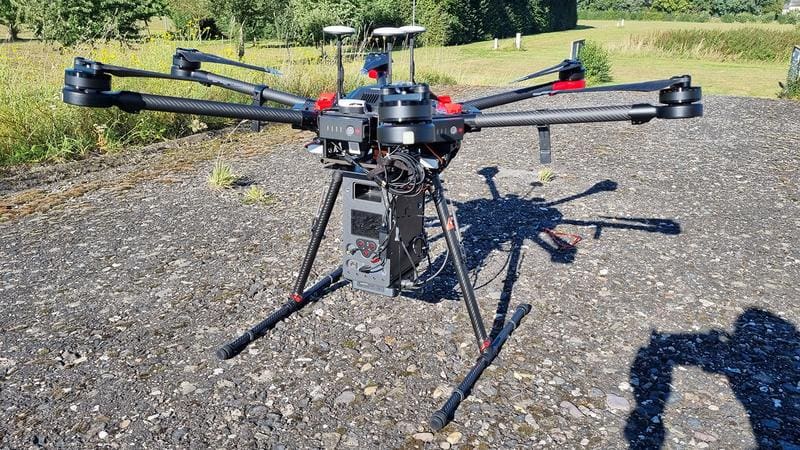
The drone is equipped with a gamma detector, electro-optical and infrared cameras, an Intel NUC computer, IMU and LTE stick. Cameras detect objects such as people or vehicles and transmit live images. The system is the result of the HUGIYN project. In the follow-up project SLEIPNIR, the airspeed is to be increased and several nuclides (e.g. cesium, cobalt) are to be localized simultaneously.
In zones that are too dangerous, unmanned ground vehicles (UGVs) provide support. The Cognitive Mobile Systems department led by Dr. Frank E. Schneider develops CBRNE robots with intelligent sensor fusion, autonomous navigation and assistance functions. Radiation values are compared with normal values of the nationwide gamma local dose rate measurement network (approx. 1700 measuring points) and merged into heat maps.
The “Click & Grasp” system allows the autonomous gripping, measuring, transport and depositing of hazardous substances at the click of a mouse in the live video. Complex movements such as opening car doors succeed. The “jacket control” intuitively transfers arm movements of the operator to the robot – even for non-specialized emergency personnel. A photorealistic 3D model creates enhanced situational awareness through virtual angles.
The combination of drones and robots creates an efficient, remote reconnaissance and recovery of CBRNE hazardous substances and makes a significant contribution to the safety of emergency services and the population.
Editor: X-Press Journalistenbüro GbR
Gender Notice. The personal designations used in this text always refer equally to female, male and diverse persons. Double/triple naming and gendered designations are used for better readability. ected.
Most read
 New S3 guideline: ASA as an option for thrombosis prophylaxis in hip and knee surgery The updated S3 guideline for the prophylaxis of venous thromboembolism (VTE) recommends acetylsalicy...
- New MRI methods for the early detection of Parkinson’s disease: Campus Lübeck is looking for study participants Researchers at the University Medical Center Schleswig-Holstein (UKSH) and the Universities of Lübec...
- The personal health check of the UMG laboratory: The detectives of blood The Personal Health Check of the UMG Laboratory (Interdisciplinary Laboratory of the University Medi...