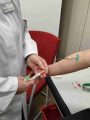
Breakthrough: Microscope method detects rare platelet disorders with a drop of blood
Researchers at the University Medical Center Greifswald have developed an examination method that can be used to detect congenital platelet disorders in newborns with just one drop of blood. The procedure is intended to shorten the diagnosis path, which often takes years, for more than 70 known hereditary platelet disorders.
Affected patients often suffer from impaired hemostasis and spontaneous large bruising since childhood. The correct diagnosis has so far been difficult and lengthy. The new technique uses immunofluorescence microscopy, in which specific structures of the platelets are visualized with fluorescent antibodies.
For the first screening examination, a single drop of blood is sufficient. Samples can be sent by post to one of seven international specialist centres. This makes diagnostics accessible even to patients who live far away from an expert center. In addition, the procedure is intended to reduce costs by providing information on which patients a further genetic analysis makes sense.
The study was conducted under the auspices of the International Society on Thrombosis and Haemostasis (ISTH) and published in its journal. In addition to Greifswald, other partners from various countries are involved in the global network with seven centres.
The method was developed in Greifswald to save patients long journeys and to make diagnostics more accessible internationally. The University Medical Center Greifswald sees this as a further strengthening of its reputation as an international reference center for diseases of blood clotting and platelets.
Editor: X-Press Journalistenbüro GbR
Gender Notice. The personal designations used in this text always refer equally to female, male and diverse persons. Double/triple naming and gendered designations are used for better readability. ected.
Most read
 Miraculous fitness probiotic: Roseburia inulinivorans massively improves muscle strength Researchers from the University of Granada, the University of Almería and the Leiden University Medi...
- The personal health check of the UMG laboratory: The detectives of blood The Personal Health Check of the UMG Laboratory (Interdisciplinary Laboratory of the University Medi...
- ASKED: “The new GOÄ is a far greater danger than some people realize” The new fee schedule for doctors (GOÄ) provides for significant cuts for laboratory medicine. DGKL b...