
Brain organoids clarify the causes of rare developmental disorders
An international research team has investigated the causes of a rare microcephaly disorder with the help of human brain organoids. The German Primate Center, the Hannover Medical School and the Max Planck Institute of Molecular Cell Biology and Genetics were involved. The results explain how mutations in actin genes impair brain development.
Microcephaly leads to a brain that is too small and occurs in children. The study focuses on Baraitser-Winter syndrome, a rare disease caused by mutations in actin genes. Actin forms the cytoskeleton, which ensures stability and transport in cells. Changes in this protein interfere with the division of early progenitor cells in the brain, resulting in lower cell counts and reduced brain growth.
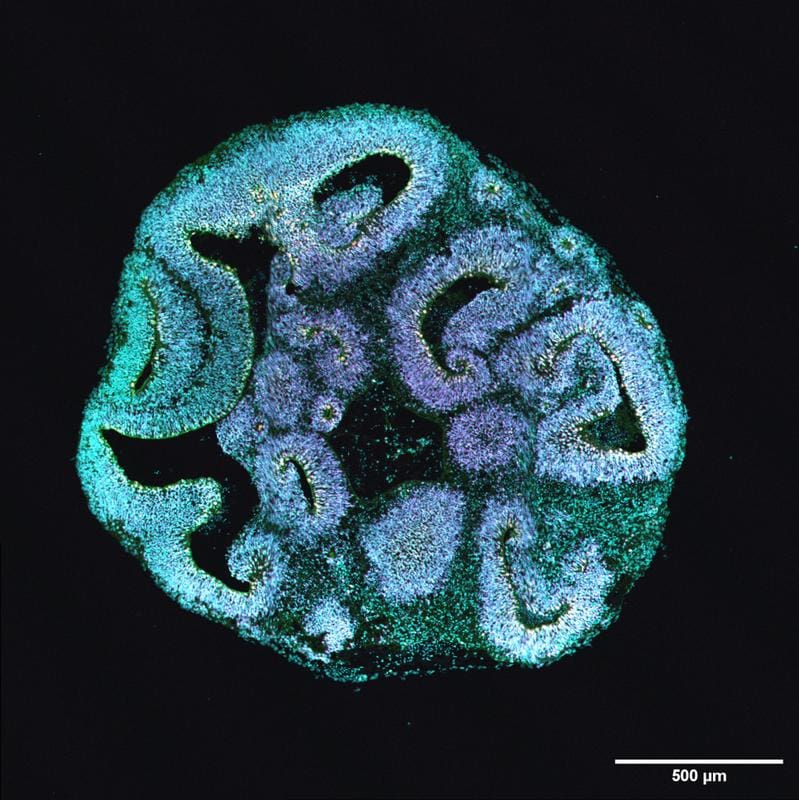
The researchers generated pluripotent stem cells induced from patients’ skin cells and used them to create three-dimensional brain organoids. These models simulate early stages of brain development. After 30 days of growth, the organoids from patient cells were a quarter smaller than control organoids from healthy donors. The ventricle-like structures in which progenitor cells form nerve cells also showed a significant reduction in size.
A detailed analysis of the cell types revealed a shift: the proportion of apical progenitor cells, central to the cerebral cortex, was reduced. Instead, more basal progenitor cells formed, which normally develop later. High-resolution microscopy revealed the cause: the division of apical progenitor cells was disturbed. Normally, they divide perpendicular to the surface to create two identical progenitor cells. In the patient organoids, horizontal or oblique divisions predominated, resulting in less self-renuation and more conversion into basal cells.
Electron micrographs showed irregular cell shapes in the ventricular zone with protrusions between cells and increased tubulin at junctions. Tubulin, another cytoskeleton building block, influences cell division. These changes are sufficient to permanently disrupt the division alignment, although the basic cell architecture is preserved.
To confirm causality, the researchers modified healthy stem cells with CRISPR/Cas9 to introduce the same mutation. The resulting organoids had identical defects, which identifies the mutation as the sole cause.
The findings explain how genetic changes cause complex brain malformations. Brain organoids are proving to be a valuable tool for biomedical research. In diagnostics, the results help to better classify genetic findings. Therapeutically, drugs that modulate the interaction of actin and microtubules could offer new approaches, although early fetal processes make them difficult to use.
Original Paper:
Editor: X-Press Journalistenbüro GbR
Gender Notice. The personal designations used in this text always refer equally to female, male and diverse persons. Double/triple naming and gendered designations are used for better readability. ected.
Most read
 Miraculous fitness probiotic: Roseburia inulinivorans massively improves muscle strength Researchers from the University of Granada, the University of Almería and the Leiden University Medi...
- The personal health check of the UMG laboratory: The detectives of blood The Personal Health Check of the UMG Laboratory (Interdisciplinary Laboratory of the University Medi...
- ASKED: “The new GOÄ is a far greater danger than some people realize” The new fee schedule for doctors (GOÄ) provides for significant cuts for laboratory medicine. DGKL b...