Automated Analytics: A Milestone for Laboratory Diagnostics
Clinical mass spectrometry is considered the gold standard due to its high sensitivity, but has often been too personnel-intensive for everyday clinical practice. Bioscientia in Ingelheim is now showing how the integration of fully automated solutions enables the leap into 24/7 routine operation. Intuitive operation and efficient workflows relieve the team, while at the same time increasing the quality of patient care through the use of LC-MS/MS in the central laboratory.
Technology Change: The Integration of Mass Spectrometry into Laboratory Operations
Clinical liquid chromatography with tandem mass spectrometry (LC-MS/MS) is used in analytics due to its specificity and sensitivity. Despite these properties, the application in clinical chemistry has often been limited to specialized areas so far. The reasons for this lay in the structural requirements: The processes were considered personnel-intensive, required specialist personnel with LC-MS/MS knowledge and were difficult to integrate into the processes of central laboratories due to manual steps.
Systemic integration into laboratory automation
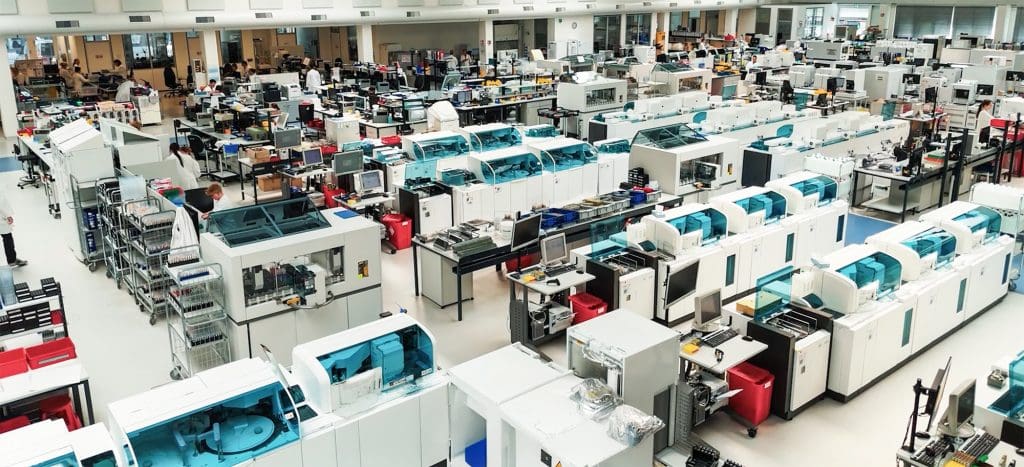
In order to make mass spectrometry more widely usable for patient care, the step from the manual island solution to the fully automated system was decisive. At Bioscientia in Ingelheim, this was achieved by adding the cobas® i 601 analysis module from Roche to the laboratory line. This step makes it possible to integrate the LC-MS/MS procedure into the existing system landscape and to transfer it into the routine of the central laboratory.
Dr. Oliver Harzer, CEO of Bioscientia, states: “With cobas® Mass Spec, we are bringing clinical mass spectrometry into routine for the first time – a real milestone for us and the future of laboratory diagnostics.” The aim of this conversion is to transfer parameters with a high volume of samples from special analysis to the automated central laboratory environment.
Requirements for personnel and operational processes
An essential aspect in the introduction of this technology is the personnel coverage in shift operation. While conventional LC-MS/MS processes often require expert knowledge, automation changes the requirement profile. “You don’t need any previous knowledge of mass spectrometry to operate the cobas® i 601 analysis module, as the system runs very independently,” reports Tanja Westenberger, MTLA in the vending machine laboratory. Thanks to software-supported user guidance and automated processes, the system can be integrated into regular operation.
This organization of workflows allows laboratories to allocate personnel capacities differently. Frank Exner, COO at Bioscientia, states that automating high-throughput samples takes the pressure off the team. This frees up capacity for teams of experts and leaves more time for specialists to work on special parameters.
Throughput and Quality Assurance Data
In the application, the capacity of the system becomes clear for parameters such as vitamin D, where throughput rates of 400 to 500 orders per day are achieved. The daily maintenance effort for the module amounts to about five minutes.
The standardization of these processes contributes to the comparability of the results. Dr. Maria Shipkova, a specialist in laboratory medicine, summarizes: “We are reaching a new level of quality in clinical mass spectrometry – fully automated and harmonized.” This establishes LC-MS/MS as a component of automated laboratory diagnostics.
Strong partnership with a clear outlook
Die Implementierung des Systems markiert den Beginn einer langfristigen Ausweitung der automatisierten Analytik, die auf der engen strategischen Kooperation zwischen Roche und Bioscientia basiert. Ein direkter Austausch ermöglicht es dabei, praktische Erfahrungswerte kontinuierlich in die Weiterentwicklung des Systems einfließen zu lassen. Zukünftig plant Bioscientia, das Spektrum auf weitere Parameter wie Steroidhormone und Arzneistoffe auszudehnen, um die Kapazitäten der automatisierten Massenspektrometrie für die Patientenversorgung voll auszuschöpfen.
Link to the experience report:
Bioscientia: Clinical Mass Spectrometry in the Routine Laboratory
The respective companies are responsible for the content of the “Corporate News” section
Most read
 Review: Roche Laboratory Forum 2026 – The laboratory as a strategic control centre The Roche Laboratory Forum 2026 in Mannheim was a complete success. We would like to thank all parti...
- Choosing POCT devices based on evidence: Which studies are really relevant Point-of-care diagnostics (POCT) is becoming increasingly important, while at the same time the numb...
- Wassermanagement in der klinischen Diagnostik: Die unterschätzte Ressource Reinstwasser kommt nicht einfach „aus dem Hahn“: In der Routine hängt die Zuverlässigkeit vieler Ana...