
AI-powered database optimization is taking shape
A research team led by Shaojie Qiao has published a comprehensive overview of AI4DB , which uses artificial intelligence to improve database optimization. The work was published on December 15, 2025 in Frontiers of Computer Science, published by Higher Education Press and Springer Nature.
Traditional database optimization methods reach limits for large amounts of data, complex queries, and dynamic workloads, resulting in suboptimal performance and higher costs. AI4DB integrates machine learning and deep learning to address these challenges. The overview focuses on four key areas.
In cardinality and cost estimation, traditional techniques do not adequately capture correlations between columns and tables, resulting in errors. Deep learning approaches improve this by capturing table correlations and taking into account factors such as hardware overhead.
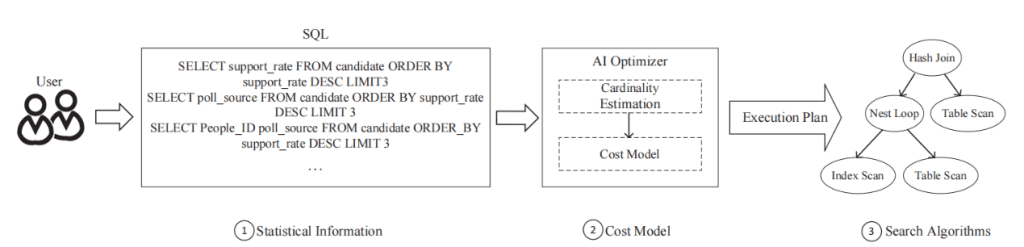
Join order selection in complex scenarios uses traditional optimizers heuristic algorithms or dynamic programming, but fails for large amounts of data due to the NP hardness of the problem. Deep reinforcement learning enables automatic selection of optimal plans through iterative feedback.
End-to-end optimizers use deep neural networks to consider complex environments and generate optimal execution plans for SQL queries.
Text-to-SQL models convert natural language into executable SQL queries, making it easier to access databases without SQL knowledge.
Future directions, according to the paper, include adaptive models for changing data distributions, more robust text-to-SQL systems for real-world language variations, federated and transfer learning for scalability, and integration with edge computing and IoT for distributed computing.
According to the authors of the study, these advances promise more efficient, intelligent database systems for experts and laypeople.
Original Paper:
Read more:
Editor: X-Press Journalistenbüro GbR
Gender Notice. The personal designations used in this text always refer equally to female, male and diverse persons. Double/triple naming and gendered designations are used for better readability. ected.
Most read
 First female dean in 549 years: Professor Sara Y. Brucker heads the Faculty of Medicine in Tübingen For the first time in its almost 550-year history, the Faculty of Medicine at the University of Tübi...
- Lifesaver laboratory medicine: “As a rule, a result should be available after 60 minutes at the latest for emergencies.” 11.2 is the day of the emergency call - but for laboratory medicine it is only one of 365 days on wh...
- Carnival 2026: Sex, falls, cuts and alcohol In the carnival week from Weiberfastnacht, the number of injured people in many emergency rooms incr...