New mechanism of pathological vascularization discovered in diabetic eye
An international research team led by Professor Dr. Jens Kroll from the Medical Faculty Mannheim of the University of Heidelberg has elucidated a previously unknown molecular mechanism of pathological vascularization in the eye. The process plays a central role in serious eye diseases such as diabetic retinopathy and age-related macular degeneration, which can lead to permanent visual disturbances and even blindness.
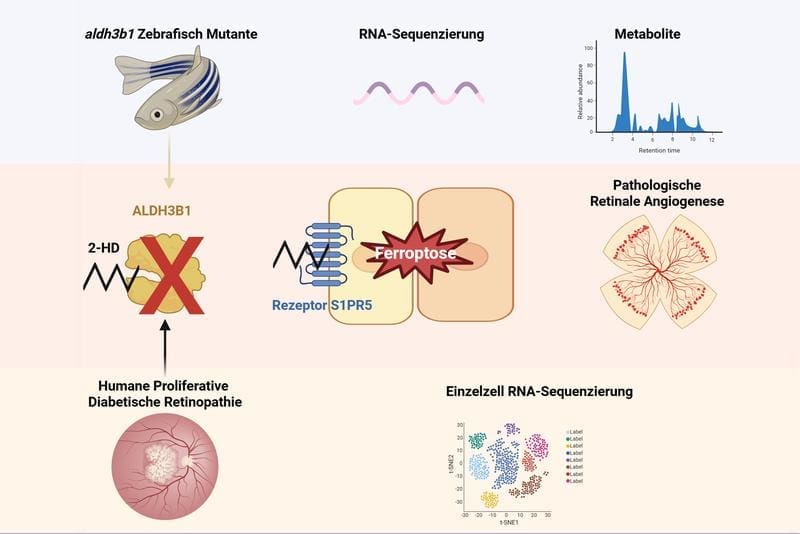
The focus is on the messenger substance sphingosine-1-phosphate (S1P) and its degradation product 2-hexadecenal (2-HD). The researchers were able to show that an excess of 2-HD inhibits the S1P receptor 5 (S1PR5). This leads to a disturbance of the iron balance in the cells, triggers ferroptosis (an iron-dependent cell death driven by lipid peroxidation) and thus promotes the pathological formation of new blood vessels in the retina.
The results were published in the journal Nature Communications . The studies used, among other things, the zebrafish model and data from patients. Targeted blockade of 2-HD or stabilization of the S1PR5 receptor significantly reduced pathological vascularization in animal models.
Promising therapeutic approach
Of particular relevance is the fact that there are already approved drugs that modulate the S1PR5 receptor (currently used primarily in multiple sclerosis). These could also potentially be used for the treatment of eye diseases and could be an alternative or supplement to current VEGF inhibitors, which often have to be injected repeatedly and can have side effects.
“The newly identified signaling axis around 2-hexadecenal and S1PR5 opens up alternative drug therapy approaches that could be more targeted and possibly have fewer side effects,” says Professor Kroll.
The study provides new insights into the pathogenesis of diabetic eye diseases and could lead to more effective and patient-friendly treatments in the long term. Further studies are now to clarify how this mechanism can be used therapeutically.
Original Paper:
Read Also:
Elevated glucagon levels in type 2 diabetes detectable early after diagnosis – MedLabPortal
Editor: X-Press Journalistenbüro GbR
Gender Notice. The personal designations used in this text always refer equally to female, male and diverse persons. Double/triple naming and gendered designations are used for better readability ected.
Most read
 Wal Timmy: Environment Minister Backhaus ignored rescue technology that has been in place since 1983 The stranded humpback whale "Timmy" suffered severely for days in Mecklenburg-Western Pomerania beca...
- Impending fuel shortage: “If the laboratory fails, medical care will come to a standstill in large parts” DGKL CEO Jan Wolter explains the dramatic consequences of a potential fuel shortage for laboratory m...
- Hantavirus: detection, symptoms, therapy What is hantavirus? Hantaviruses are a group of viruses that occur worldwide and are mainly transmit...