analytica 2026: More sustainability in the laboratory
Concepts and inspiration for the green laboratory are at the top of the agenda at analytica 2026. The world’s leading trade fair for laboratory technology, analytics and biotechnology will take place in Munich from March 24 to 27, 2026.
Innovative analytical instruments, fewer toxic chemicals and more artificial intelligence: At analytica 2026, exhibitors and researchers from all over the world will show how daily laboratory work can be made more sustainable. “analytica sees itself as a signpost to the green laboratory,” emphasizes Exhibition Director Susanne Grödl. Green Lab concepts therefore run like a red thread through the trade fair, analytica conference and the extensive supporting program.
New measurement techniques make a decisive contribution to greater sustainability in the laboratory . The best example of this are the “electronic noses” from Plasmion. The analytica exhibitor has developed an ionization technique for mass spectrometry that detects traces of pollutants and other substances in solid, liquid or gaseous samples – without time-consuming sample preparation. This reduces the consumption of chemicals and other materials on its own.
In instrumental analytics, a lot has happened in terms of sustainability anyway. Supercritical fluid chromatography (SFC chromatography), which uses liquid CO2 as the mobile phase, also ensures greater sustainability. This not only saves organic solvents, but also reduces energy requirements, because the lower viscosity of the supercritical CO2 reduces pumping costs. All major suppliers of SFC systems are represented at analytica, including Agilent, Knauer, PerkinElmer, Shimadzu, Thermo Fisher and Waters.
© Messe München GmbH
Mini components from the 3D printer
In the analytica conference session “Towards sustainable HPLC”, SFC chromatography is also on the agenda (March 24, 09:30-11:30). Another focus of this session is on miniaturization, because smaller devices require fewer solvents and other chemicals. Microfluidic chips for high-performance liquid chromatography (HPLC), for example, can be produced with 3D printers and connected to common pumps and detectors. Miniaturization and 3D printing will also be the focus of the session “Green analytical labs of the future” (March 25, 3:00-5:00 p.m.). The highlight here is a 3D-printed laboratory system called 2LabsToGo-Eco, which combines chromatography and bioassays and is powered by solar power.
analytica Forums: Regulation and Best Practice Examples
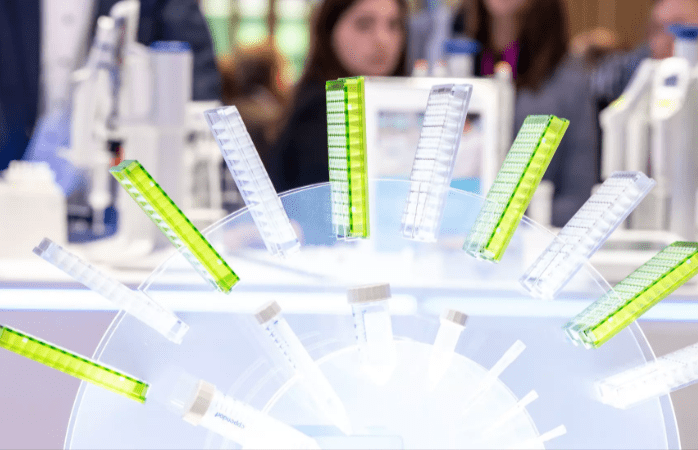
If you want to find out about legal requirements for sustainability in the laboratory, you should not miss the analytica forums. Here, visitors will also learn how to implement green concepts in their laboratory using best-practice examples. There will be inspiration, among other things, on plastic consumables that laboratories can hardly do without. It’s good to know that analytica exhibitors such as Eppendorf, Integra, and Omnilab are already converting their portfolios in the direction of sustainability. Eppendorf, for example, already produces tubes, pipette tips and other selected consumables from bio-based plastics.
Last but not least, digitization and artificial intelligence play a key role in the Green Lab. Because if AI calculates workflows and test designs optimally, energy and consumables can be easily saved. Digital data acquisition and AI-supported evaluation also increase the gain in knowledge, so that some measurements are completely superfluous. In the analytica special show “Digital Transformation”, visitors will experience digitized workflows in action.
“The green laboratory becomes reality when measures in a wide variety of areas interlock,” emphasizes Susanne Grödl. “With analytica, we are bringing together players along the entire value chain and thus setting in motion the processes that will make the Green Lab a reality.”
Editor: X-Press Journalistenbüro GbR
Gender Notice. The personal designations used in this text always refer equally to female, male and diverse persons. Double/triple naming and gendered designations are used for better readability. ected.
Most read
 Hantavirus: detection, symptoms, therapy What is hantavirus? Hantaviruses are a group of viruses that occur worldwide and are mainly transmit...
- Blood values in the blue whale (Balaenoptera musculus) Humpback whale Timmy is still keeping Germany in suspense - but what about laboratory values in whal...
- Rabbit fever infects people in Germany: symptoms, detection and blood count In Lower Saxony and Bremen, three people have already fallen ill with rabbit fever (tularemia) this...