
Hugo Geiger Prize for rapid bacterial analysis using scattered light
Dr. Anne-Sophie Munser from the Fraunhofer Institute for Applied Optics and Precision Engineering IOF in Jena has been awarded third place in the Hugo Geiger Prize. The scientist received the award for the development of a highly sensitive scattered light measurement that can detect microorganisms, bacteria and antibiotic resistance much faster than conventional methods.
In the case of bacterial infections, every hour is often decisive. Conventional diagnostics usually require several hours to days and large quantities of cells through cultivation. The new photonics-based method developed by the researcher from the Department of Functional Surfaces and Coatings at the IOF detects individual cells in fractions of a second. In microfluidic sampling, microbiological processes can be traced as early as the first two to three cell divisions. Bacteria and their possible resistances can thus be identified within about three hours.
The method uses angle-resolved scattered light analysis, which was originally developed for testing highly smooth surfaces such as mirrors or lenses. A laser beam is directed at individual cells. Depending on the structure, surface texture and shape, a characteristic light scattering is created – an optical fingerprint from which cell type, roughness, aggregation behavior and other properties down to the nanometer range can be derived. In her dissertation, Munser was able to prove that the effectiveness of antibiotics can also be assessed after just a few hours.
The technology is currently being developed into a compact, transportable system, and in the long term up to lab-on-a-chip solutions. Data evaluation is to be simplified with artificial intelligence in the future. Possible applications range from infection research and drug development to food control and drinking water monitoring to the investigation of biofilms on implants or in stem cell research.
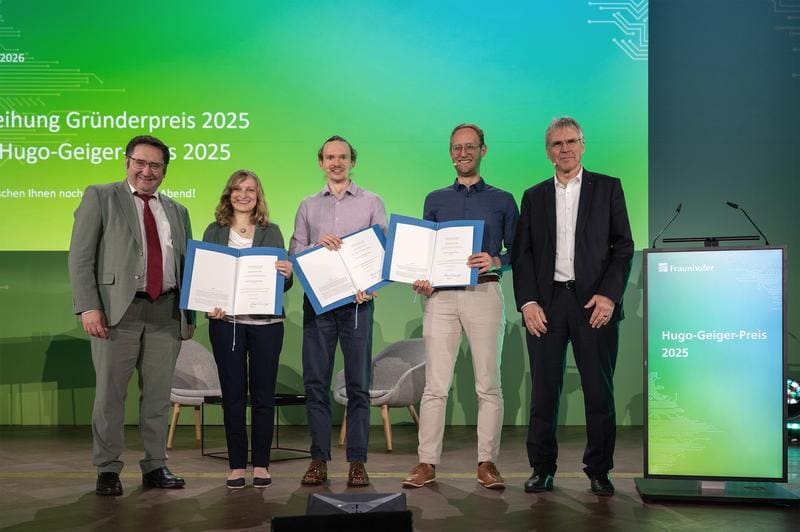
The Hugo Geiger Prize honors innovative doctoral theses that have been written in close cooperation with a Fraunhofer Institute. Scientific quality, economic relevance, novelty and interdisciplinarity are evaluated. The award was presented on March 18 at the Fraunhofer Network Symposium in Munich by the Bavarian State Secretary for Economic Affairs, Tobias Gotthardt. Munser had already received the Dr.-Ing. Siegfried Werth Prize for her work in 2024.
Editor: X-Press Journalistenbüro GbR
Gender Notice. The personal designations used in this text always refer equally to female, male and diverse persons. Double/triple naming and gendered designations are used for better readability. ected.
Most read
 Wal Timmy: Environment Minister Backhaus ignored rescue technology that has been in place since 1983 The stranded humpback whale "Timmy" suffered severely for days in Mecklenburg-Western Pomerania beca...
- Wal Timmy: Germany’s problem with euthanasia EDITORIAL. Letting Timmy suffer is more due to the German lack of experience and the bureaucratic hu...
- Impending fuel shortage: “If the laboratory fails, medical care will come to a standstill in large parts” DGKL CEO Jan Wolter explains the dramatic consequences of a potential fuel shortage for laboratory m...