
Laser-structured hydrogel as a promising bone implant
Researchers at ETH Zurich have developed a novel hydrogel that can be solidified into high-precision, bone-like structures at record speed using laser light. In the future, the soft, water-rich material will serve as a biodegradable implant to improve the healing of large bone fractures or defects after tumor removal.
The hydrogel consists of 97 percent water and three percent of a biocompatible polymer network. By adding a specially developed compound molecule and a light-sensitive initiator, it can be structured extremely quickly and precisely with focused laser pulses. Solidification only takes place in the irradiated areas, non-irradiated parts can then be washed out. This results in structures with a resolution of only 500 nanometers at a writing speed of up to 400 millimeters per second – a new world record for the structuring of hydrogels.
The ETH research group led by Prof. Xiao-Hua Qin (Biomaterials Engineering) and Prof. Ralph Müller was guided by natural bone healing: after a fracture, the body first forms soft, permeable tissue (hematoma and fibrin network) that allows cells, immune cells and nutrients to migrate before forming hard bone. The new hydrogel mimics this process and offers a porous, trabeque-like architecture with fine channels – comparable to natural bone, which contains about 74 kilometers of tunnel-like cavities per cubic centimeter.
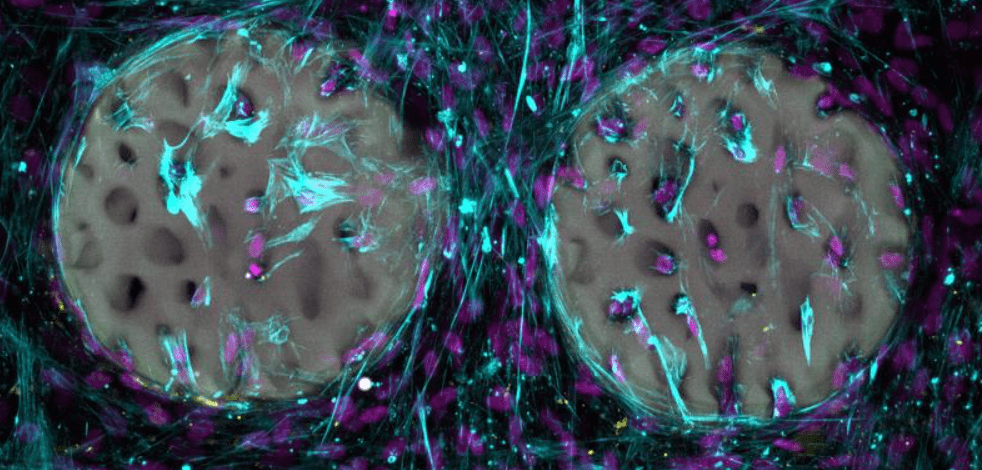
In laboratory tests, bone-forming cells (osteoblasts) quickly colonized the structured hydrogel, produced collagen and showed no damage from the material. Biocompatibility has been confirmed. Images from medical imaging served as templates for the complex structures.
Compared to conventional implants – autologous pieces of bone (autografts), metal or ceramic parts – the hydrogel offers advantages: it does not require removal at a second surgical site, it is not too rigid like metals and dissolves in the body over time while new bone is formed.
The base material has been patented. As a next step, the researchers are planning animal experiments in cooperation with the AO Research Institute Davos to test the promotion of cell migration, integration into bone tissue and the restoration of mechanical stability in the living organism. Clinical application in patients is still a long way off.
The study was published in the journal Advanced Materials.
Original Paper:
Editor: X-Press Journalistenbüro GbR
Gender Notice. The personal designations used in this text always refer equally to female, male and diverse persons. Double/triple naming and gendered designations are used for better readability. ected.
Most read
 German Medical Association calls for ban on medical diagnostics in drugstores The 130th German Medical Congress 2026 calls on legislators to prevent medical diagnostics in drugst...
- Expert Tip for Preanalytics of Glucose Determination The pre-analysis of glucose determination is a science in itself, even for experienced doctors. MedL...
- Preanalytics in glucose measurements: Centrifuged PST tubes are superior to NaF-KOx A study by Brigham and Women's Hospital and Harvard Medical School shows that centrifuged lithium he...