Almost all people with BMI ≥ 30 meet criteria for clinical obesity
An international analysis of large population and intervention studies led by Prof. Matthias Schulze from the German Institute of Human Nutrition Potsdam-Rehbrücke (DIfE) shows that almost all people with a body mass index (BMI) of at least 30 kg/m² can be confirmed as obese by at least one other anthropometric criterion. Around 80 percent of this group already have obesity-associated health impairments and thus meet the criteria for clinical obesity.
The results of the study, in which scientists from the German Center for Diabetes Research (DZD) and the University Hospital Tübingen were involved, were published in Nature Communications. Data from the US NHANES study (representative of the adult population), the EPIC Potsdam cohort and the TULIP lifestyle intervention study were evaluated.
The study evaluates the proposal of an international Lancet Commission from spring 2025 to divide obesity into preclinical and clinical forms. According to this, obesity is initially confirmed by BMI ≥ 30 and at least one other measure such as waist circumference or body fat percentage. Clinical obesity is present when additional measurable secondary problems such as high blood pressure, impaired sugar or fat metabolism can be detected.
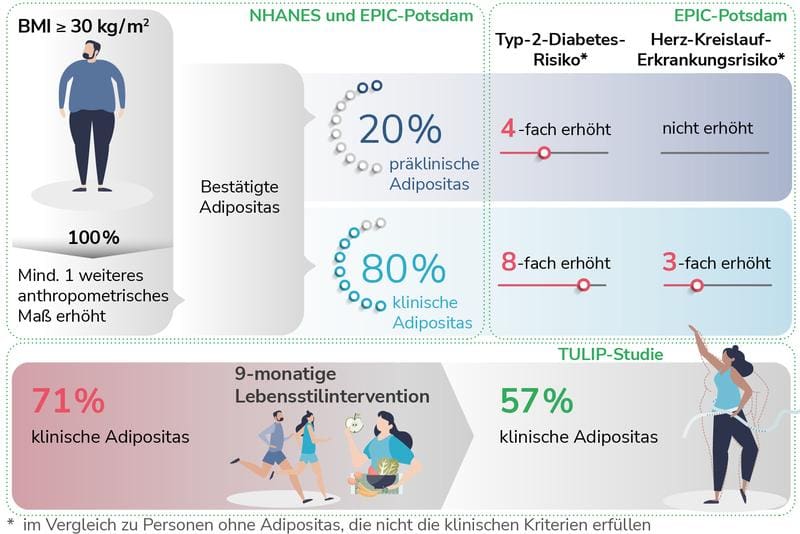
In the NHANES analysis, 100 percent of individuals with BMI-based obesity status met at least one additional anthropometric criterion. Of these, about 80 percent had clinical features. Individuals with clinical obesity had an approximately threefold higher risk of cardiovascular disease and an approximately eight-fold higher risk of type 2 diabetes compared to normal-weight individuals without these criteria. In preclinical obesity, there was no increased cardiovascular risk, but a significantly increased risk of diabetes.
A nine-month lifestyle intervention in the TULIP study reduced the proportion of clinical obesity from 71 to 57 percent and the proportion of prediabetes from 52 to 29 percent. In particular, blood pressure, triglyceride levels and blood sugar regulation improved. The success of the therapy depended, among other things, on age and liver fat content.
The authors conclude that additional anthropometric confirmation of obesity is given in almost all BMIs ≥ 30 cases and therefore often seems dispensable in practice. Less than 20 percent of those affected are considered preclinical; the majority already have measurable health consequences. Many clinical criteria overlap strongly, which calls into question the need for extensive diagnostics for subdivision.
The results provide an evidence-based basis for evaluating the new Lancet definition. In the future, clinical obesity could be classified as an independent disease with clear treatment indications. The researchers plan to make comparisons with established concepts such as metabolically healthy versus unhealthy obesity.
Obesity has been a disease of the WHO since 1948 and is listed in the ICD-11 as a chronic complex disease (code 5B81). The debate as to whether it is an independent disease or primarily a risk factor remains. The proposed criteria are intended to enable more precise coverage and improve access to medical care without promoting unnecessary overdiagnosis or neglect of personal responsibility.
Original Paper:
Definition and diagnostic criteria of clinical obesity – The Lancet Diabetes & Endocrinology
Editor: X-Press Journalistenbüro GbR
Gender Notice. The personal designations used in this text always refer equally to female, male and diverse persons. Double/triple naming and gendered designations are used for better readability. ected.
Most read
 Hantavirus: detection, symptoms, therapy What is hantavirus? Hantaviruses are a group of viruses that occur worldwide and are mainly transmit...
- Hantavirus: Facts instead of panic Reports of three deaths in connection with a hantavirus outbreak on the cruise ship "MV Hondius" in...
- Hantavirus: Experts at the University Medical Center Essen see low risk for the general population After several hantavirus infections and deaths occurred on the cruise ship "Hondius", a contact pers...