Mechanism of rare cerebral vein thrombosis deciphered after COVID-19 vector vaccines
A research team from the University Medical Center Greifswald, together with partners from Australia and Canada, has elucidated the mechanism that triggers cerebral vein thrombosis after vaccination with vector-based COVID-19 vaccines in extremely rare cases. The findings, which were published in the New England Journal of Medicine, open up ways to make such vaccines even safer in the future.
In 2021, Prof. Andreas Greinacher’s team had already attracted worldwide attention when they identified the cause of very rare thrombotic complications after vector vaccines. Now the new study shows that almost everyone forms antibodies against the adenovirus protein VII in the course of their lives as a result of natural infections – such as cold viruses. Upon renewed contact with adenoviruses, these antibodies are reactivated. In extremely rare cases, a mutation occurs in individual antibody-producing cells.
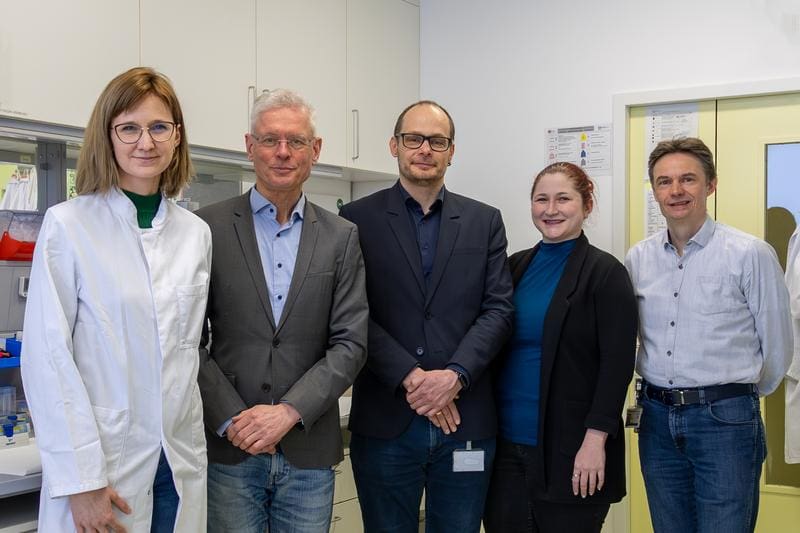
In people with a certain genetic predisposition, the modified antibody no longer binds to protein VII, but erroneously to platelet factor 4 (PF4). This activates platelets and creates clots in cerebral veins. Co-author Dr. Linda Schönborn compares the process to a key whose prongs change and suddenly fit into another lock. This combination of random mutation and genetic predisposition is so unlikely that the risk of complication remains extremely low.
Patients from all over Germany provided the team with blood samples, which enabled the detailed elucidation of the immunological mechanism. The central finding for vaccine development is that the responsible site in protein VII of the vector can be specifically modified to rule out the risk in the future. This is particularly relevant for regions where vector vaccines are used against life-threatening diseases such as Ebola.
Prof. Andreas Greinacher, head of the study, emphasized the importance for the future: Such adjustments could make vector vaccines safer for all users without impairing their effectiveness.
Original Paper:
Adenoviral Inciting Antigen and Somatic Hypermutation in VITT | New England Journal of Medicine
Editor: X-Press Journalistenbüro GbR
Gender Notice. The personal designations used in this text always refer equally to female, male and diverse persons. Double/triple naming and gendered designations are used for better readability. ected.
Most read
 Hantavirus: detection, symptoms, therapy What is hantavirus? Hantaviruses are a group of viruses that occur worldwide and are mainly transmit...
- Impending fuel shortage: “If the laboratory fails, medical care will come to a standstill in large parts” DGKL CEO Jan Wolter explains the dramatic consequences of a potential fuel shortage for laboratory m...
- Hantavirus: Facts instead of panic Reports of three deaths in connection with a hantavirus outbreak on the cruise ship "MV Hondius" in...