Metastases: Study from Regensburg and Erlangen refutes old assumption
Metastases have long been considered localized offshoots of a primary tumor that settle in a new organ and only continue to grow there without forming new metastases themselves. A recent study by the Clinic and Polyclinic for Internal Medicine III of the University Hospital Regensburg (UKR) and the University of Erlangen-Nuremberg now clearly refutes this idea.
The research team led by Dr. Raquel Blazquez (Head of the Laboratory for Translational Metastasis at the UKR) and Prof. Dr. Tobias Pukrop (Head of the Center for Translational Oncology and Director of the Comprehensive Cancer Center East Bavaria, CCCO) has been investigating what metastases actually do after settling in other organs for over ten years. The results, published in the journal Molecular Cancer, show that metastases can pursue fundamentally different spread strategies.
Within the framework of the Collaborative Research Center TRR305, the work focused on the biology of brain metastases. A wide range of behavioural patterns was identified:
- Some metastases remain largely localized and grow predominantly in one place.
- Others are much more aggressive: individual cancer cells detach very early – often even before the original metastasis can be detected with state-of-the-art imaging. These cells settle elsewhere in the same organ and can grow there even faster than the initial metastasis.
These differences have hardly been systematically investigated so far and do not play a role in everyday clinical practice. The long-standing assumption that metastases themselves do not form new metastases is now considered to have been refuted.
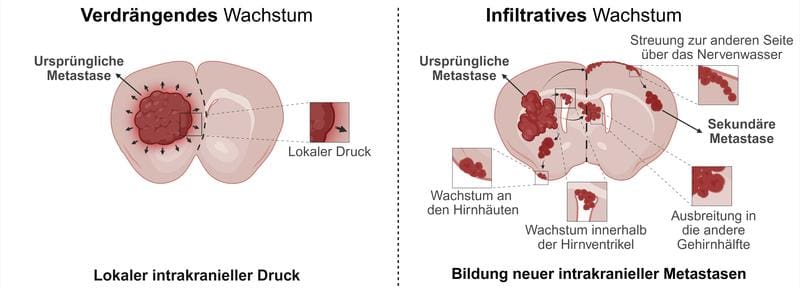
The researchers emphasize that the different behavior can strongly influence the course of the disease and could have an impact on therapy decisions in the future. However, the clinical implementation is still pending. The results form the basis for new approaches and possible innovative therapeutic strategies that have not been considered so far.
Dr. Blazquez, who was instrumental in driving the work on the basis of the hypothesis of different growth patterns, is surprised by the clarity of the results – a rare finding, especially in new scientific terrain. The publication in Molecular Cancer highlights the novelty, precision and potential of the work.
The team now plans to carefully investigate the findings further and verify them in clinical trials. The aim is to quickly translate the new findings into concrete benefits for patients and to develop therapy options that specifically target aggressive, spreading metastases.
Editor: X-Press Journalistenbüro GbR
Gender Notice. The personal designations used in this text always refer equally to female, male and diverse persons. Double/triple naming and gendered designations are used for better readability. ected.
Most read
 Hantavirus: detection, symptoms, therapy What is hantavirus? Hantaviruses are a group of viruses that occur worldwide and are mainly transmit...
- Impending fuel shortage: “If the laboratory fails, medical care will come to a standstill in large parts” DGKL CEO Jan Wolter explains the dramatic consequences of a potential fuel shortage for laboratory m...
- Hantavirus: Facts instead of panic Reports of three deaths in connection with a hantavirus outbreak on the cruise ship "MV Hondius" in...