Study shows new way to reconstruct fragrances in museums
A study published in the journal Frontiers in Environmental Archaeology describes how biomolecular data from archaeological finds can be translated into science-based odor reconstructions. The approach opens up new possibilities for museums and cultural institutions for storytelling, knowledge transfer and immersive exhibitions.
Advances in biomolecular archaeology show that historical objects preserve not only visible traces but also molecular residues from earlier fragrance and aroma practices. These provide insights into perfumery, medicine, rituals and everyday life of past societies.
Led by archaeochemist Barbara Huber from the Max Planck Institute for Geoanthropology and the University of Tübingen, an interdisciplinary team developed a research framework that transforms such biomolecular data into experiential odor reconstructions. Among others, fragrance storytelling consultant Sofia Collette Ehrich and perfumer Carole Calvez were involved.
A central component was the creation of an olfactory briefing that combines scientific analyses with the practice of perfumery. Based on this, fragrance compositions were created that translate chemical signatures of historical materials into harmonious smells suitable for museum contexts. The reconstruction takes into account the complexity of the overall impression and not just isolated individual components.
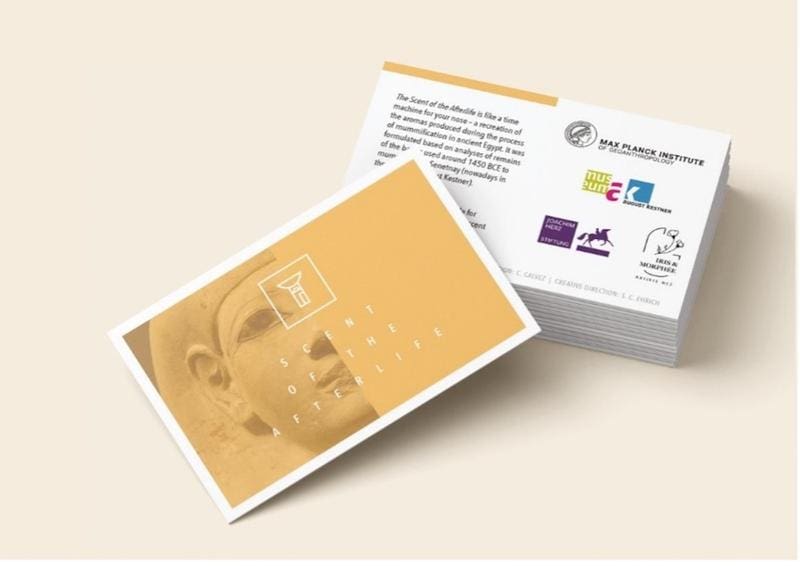
For practical implementation, the team developed two formats: portable scent cards and permanently installed scent diffusion stations. Both were tested using the example of a reconstruction of the ancient Egyptian mummification process entitled “The Scent of the Afterlife”.
At the Museum August Kestner in Hanover, the scent map has been integrated into guided tours, where it opens up a new approach to the topic of mummification – away from common clichés and towards a better understanding of ancient practices and their cultural significance. At the Moesgaard Museum in Aarhus (Denmark), a scent station was used in the exhibition “Ancient Egypt – Obsessed with Life”, which offered visitors an emotional and sensory complement to the textual and visual content.
The study shows how molecular traces of the past can be transformed into culturally significant, multisensory experiences. The aim is to provide museums with concrete tools to bring historical environments and practices closer through smell and other senses.
Original paper:
From Biomolecular Traces to Multisensory Experiences: Bringing Scent Reproductions to Museums and Cultural Heritage.
Sofia Collette Ehrich, Carole Calvez, Christian E. Loeben, Ulrike Dubiel, Steffen Terp Laursen and Barbara Huber
Publication: Frontiers in Environmental Archaeology
DOI: 10.3389/fearc.2025.1736875
Editor: X-Press Journalistenbüro GbR
Gender Notice. The personal designations used in this text always refer equally to female, male and diverse persons. Double/triple naming and gendered designations are used for better readability. ected.
Most read
 Hantavirus: detection, symptoms, therapy What is hantavirus? Hantaviruses are a group of viruses that occur worldwide and are mainly transmit...
- Hantavirus: Facts instead of panic Reports of three deaths in connection with a hantavirus outbreak on the cruise ship "MV Hondius" in...
- Rabbit fever infects people in Germany: symptoms, detection and blood count In Lower Saxony and Bremen, three people have already fallen ill with rabbit fever (tularemia) this...