
Humanoid Robots Lab: University of Bonn opens research supermarket
The University of Bonn has opened its own supermarket. On an area of 55 square meters, scientists are investigating the purchasing behavior of test subjects. Products such as pineapples, canned tomatoes and bread dumplings are sorted on black shelves. The store is for purely scientific purposes and is not intended for public sale. Researchers from food and resource economics, psychology, economics and behavioural research are testing how product placement and other incentives motivate health- and sustainability-oriented purchases. Robots will also demonstrate their capabilities in loading the shelves.
Nowhere does the supermarket appear on the outside. The white building Am Probsthof gives no indication of the contents. There is no advertising, as the market is only for studies. Participants are selected as test subjects and move between the shelves. Cameras record the decisions, whereby software makes identification impossible. Only silhouettes are recognizable to determine whether test subjects reach for certain pack variants.
The focus is on incentives for healthy and sustainable products. Nowhere else are consumers influenced as strongly as in the supermarket. Researchers are examining whether fruit instead of sweets at the checkout area increases sales. Bananas near the checkout are bought a third more often than in other places. The study examines how packages must be placed and designed so that sustainably produced goods can be sold despite higher prices. Animal welfare products should receive advantages despite costs.
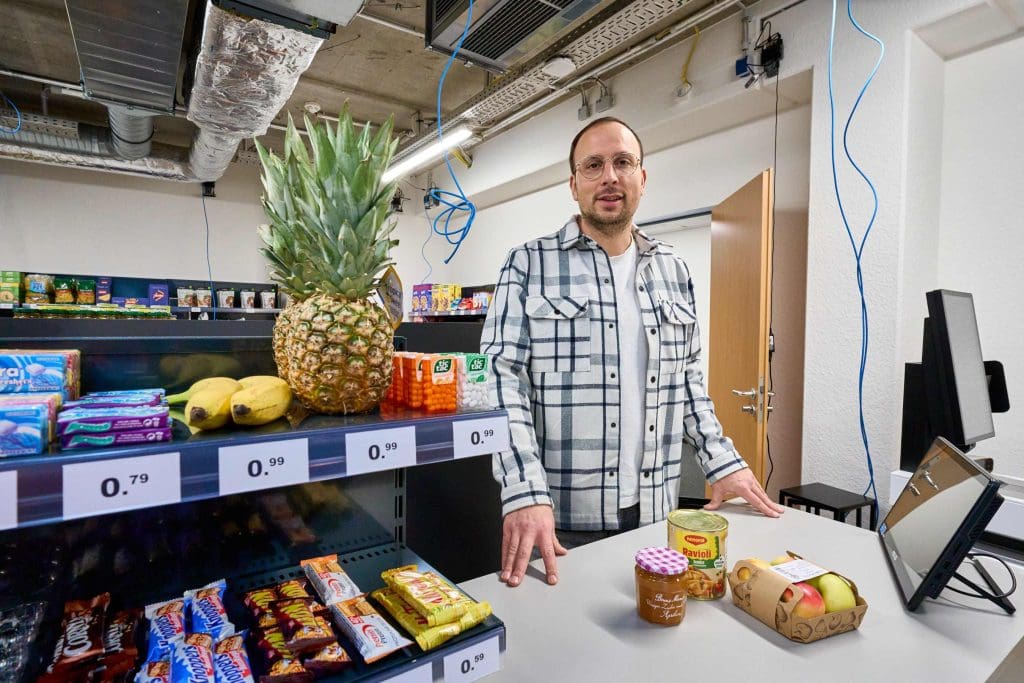
The supermarket is more realistic than virtual models. Earlier experiments at the University of Bonn used screens in which test subjects controlled a shopping cart and selected products. This was more valid than surveys, but the physical store enables natural behavior. Participants fall more easily into habits that are evaluated. Impulse purchases that deviate from the shopping list offer insights.
The Humanoid Robots Lab at the University of Bonn is testing loading efficiency. Robots learn customer-oriented behavior. Results optimize systems for supermarkets and domestic applications such as home help or care. The institution was created through contributions from several faculties and departments. Start-up funding came from central funds, the Faculty of Agricultural, Nutritional and Engineering Sciences, Transdisciplinary Research Areas Modelling and Sustainable Futures as well as the Humanoid Robots Lab and the Centre for Artificial Intelligence.
Interested parties can register as test subjects on a website. After registering, select Experiment and Time. They receive a voucher and are allowed to take selected goods with them. Remaining products close to the best-before date go to food banks or aid initiatives to maintain sustainability.
The supermarket addresses central questions of consumer behaviour. In times of increasing health and environmental awareness, findings can influence trade and politics. Studies examine whether healthy alternatives at whining zones promote consumption. Sustainable products are to become more attractive despite the price difference. The method combines observation with data protection and enables valid results.
The institution underlines Bonn’s role in behavioral research. It combines economics, psychology and technology. Future projects could expand robot integration. The market serves as a model for similar laboratories and could set standards for sustainable trade. Research contributes to the reduction of overconsumption and waste. Realistic scenarios make results more relevant in practice.
The opening marks a milestone. Researchers expect data on impulses for conscious shopping. The combination of man and machine opens up new perspectives. In the long term, the supermarket could contribute to healthier eating habits and make retail more environmentally friendly.
Editor: X-Press Journalistenbüro GbR
Gender Notice. The personal designations used in this text always refer equally to female, male and diverse persons. Double/triple naming and gendered designations are used for better readability. ected.
Most read
 Wal Timmy: Environment Minister Backhaus ignored rescue technology that has been in place since 1983 The stranded humpback whale "Timmy" suffered severely for days in Mecklenburg-Western Pomerania beca...
- Wal Timmy: Germany’s problem with euthanasia EDITORIAL. Letting Timmy suffer is more due to the German lack of experience and the bureaucratic hu...
- Impending fuel shortage: “If the laboratory fails, medical care will come to a standstill in large parts” DGKL CEO Jan Wolter explains the dramatic consequences of a potential fuel shortage for laboratory m...