CRISPR nuclease Cas12a3 blocks protein production in infected cells
An international research team from Würzburg, Braunschweig and the USA has discovered a previously unknown CRISPR-Cas variant. The nuclease Cas12a3 specifically cuts the conserved 3′ tail of transfer RNAs (tRNAs) and thus paralyzes protein production in infected bacterial cells.
Bacteria fend off viral attacks through various mechanisms, including CRISPR-Cas systems. These use RNA-controlled Cas nucleases to recognize foreign genetic material and render it harmless. Known variants usually cut DNA or degrade RNA and DNA in a non-specific way. Cas12a3 pursues a different approach: After recognizing foreign RNA, it binds specifically to the 3′ tail of tRNAs and cleaves it. The tail carries the activated amino acid and is essential for protein biosynthesis. Its removal blocks the translation of mRNA into proteins, puts the cell in a dormant state and prevents virus replication.
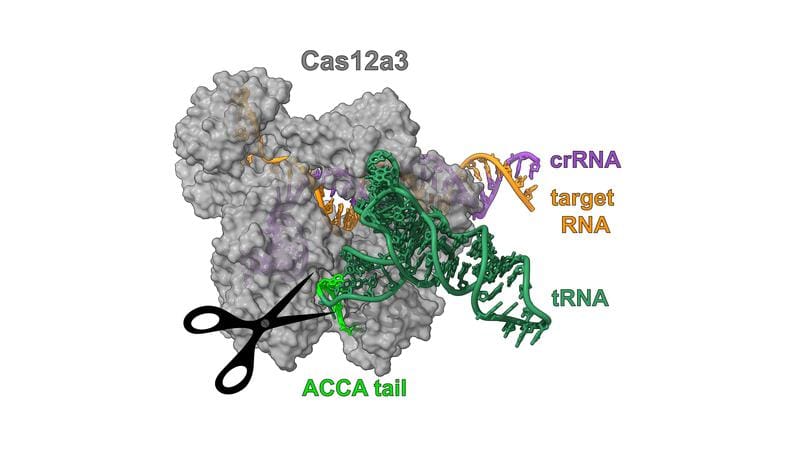
The discovery resulted from studies of the Cas12a2 family, which degrades both DNA and RNA. Cas12a3 is the precise counterpart. Using cryo-electron microscopy, a special tRNA charging domain was identified that positions the tail exactly.
The team combined Cas12a3 with two other targeted nucleases and developed a detection for RNAs of influenza virus, respiratory syncytial virus (RSV) and SARS-CoV-2. This expands the possibilities of CRISPR-based diagnostics and could enable low-cost point-of-care testing.
The study underlines the functional diversity of bacterial defense systems. Further variants are to be investigated and Cas12a3 further developed for diagnostic applications.
The Helmholtz Institute for RNA-based Infection Research (HIRI) in Würzburg, the Helmholtz Centre for Infection Research (HZI) in Braunschweig, Utah State University and institutions in Poland and Austria were involved in the work.
Original Paper:
RNA-triggered Cas12a3 cleaves tRNA tails to execute bacterial immunity | Nature
Editor: X-Press Journalistenbüro GbR
Gender Notice. The personal designations used in this text always refer equally to female, male and diverse persons. Double/triple naming and gendered designations are used for better readability. ected.
Most read
 German Medical Association calls for ban on medical diagnostics in drugstores The 130th German Medical Congress 2026 calls on legislators to prevent medical diagnostics in drugst...
- Expert Tip for Preanalytics of Glucose Determination The pre-analysis of glucose determination is a science in itself, even for experienced doctors. MedL...
- Hantavirus: Experts at the University Medical Center Essen see low risk for the general population After several hantavirus infections and deaths occurred on the cruise ship "Hondius", a contact pers...