Researchers develop system for the targeted treatment of individual organs
A research team at the German Heart Center of the Charité (DHZC) has developed a method that allows gene therapy to be applied in a highly concentrated manner to a single organ for the first time – and has impressively demonstrated this in an animal model.
The work, which has now been published in the publication “JACC: Basic to Translational Science”, shows that this concept could fundamentally change the treatment of genetic diseases in the future.
In conventional, systemically administered gene therapy, the so-called vector – a “gene transporter”, so to speak – reaches the entire body via the bloodstream to reach the target organ. It docks onto cells, is taken up by them and introduces an additional or “repaired” gene into the cell.
However, many of these vectors often accumulate mainly in the liver and spleen instead of reaching the actually diseased organ. If gene therapy is to be effective, correspondingly high doses are necessary – associated with high therapy costs and, above all, with a significantly increased risk of side effects, which often severely impairs the safety of the therapy.
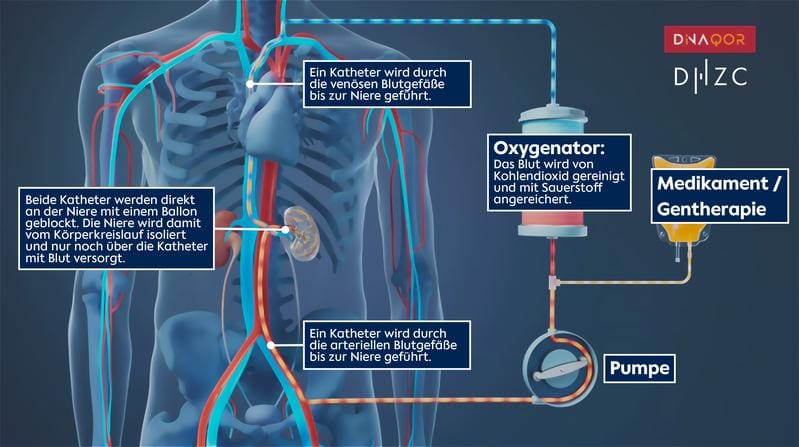
The research team at the German Heart Center of the Charité led by cardiac surgeon Prof. Maximilian Emmert therefore developed a catheter-based “closed-loop perfusion system” in cooperation with the Swiss biotechnology company DiNAQOR, which is based on the principles and function of heart-lung machines: As part of the study, two specially developed balloon perfusion catheters were used to briefly separate the kidney from the body’s circulation and place it in its own “mini-blood circulation” with oxygen-rich blood. The gene therapy vectors were then introduced only in this closed circuit (see figure).
In the isolated renal circulation, a vector concentration up to 69,000 times higher than in the rest of the body was measured. The cells of the kidneys absorbed the “gene transporters” up to 75 times more than with conventional intravenous administration – while other organs such as the liver or the spleen were almost not stressed at all.
“We were able to show that a single organ can be reached very precisely and highly effectively in a living organism – without the risks of systemic distribution,” says Maximilian Emmert. “This opens up new perspectives for gene therapies, but also for many other active ingredients such as chemotherapies or antibodies, which could be concentrated locally and at the same time administered much more gently to the rest of the body.”
In addition, the study shows that the principle can also be transferred to other organs such as the heart, lungs or liver in the long term, says Emmert.
Original Paper:
Editor: X-Press Journalistenbüro GbR
Gender Notice. The personal designations used in this text always refer equally to female, male and diverse persons. Double/triple naming and gendered designations are used for better readability. ected.
Most read
 German Medical Association calls for ban on medical diagnostics in drugstores The 130th German Medical Congress 2026 calls on legislators to prevent medical diagnostics in drugst...
- Expert Tip for Preanalytics of Glucose Determination The pre-analysis of glucose determination is a science in itself, even for experienced doctors. MedL...
- Preanalytics in glucose measurements: Centrifuged PST tubes are superior to NaF-KOx A study by Brigham and Women's Hospital and Harvard Medical School shows that centrifuged lithium he...