Mexican Pediatricians Provide Recommendations for RSV Prevention in Infants
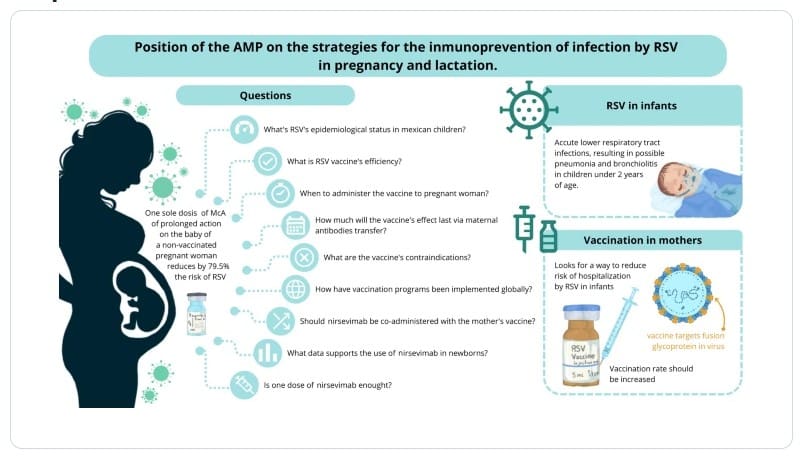
The Mexican Society of Pediatrics, in collaboration with a multidisciplinary panel of experts, has published an opinion on immune prevention against respiratory syncytial virus (RSV). The document evaluates maternal vaccinations and long-acting monoclonal antibodies as effective strategies for reducing severe RSV disease in infants in Mexico and Latin America.
RSV causes millions of respiratory infections worldwide annually and is a leading cause of hospitalization and death in children under the age of five. Infants under six months of age are particularly at high risk. In low- and middle-income countries, the disease places a heavy burden on health systems, mainly due to seasonal waves and limited access to care. Traditionally, prevention measures have been limited to at-risk groups, but new options such as maternal vaccines and monoclonal antibodies are expanding protection.
The statement is based on a systematic analysis of clinical trials, observational data and practical experience. It recommends vaccinating pregnant women with an RSV prefusion F protein vaccine, which offers over 80 percent protection against severe lower respiratory tract infections in the first three months. The effect lasts up to six months, supported by efficient antibody transfer in late pregnancy. Real-world studies confirm a significant reduction in hospital stays.
.
As an alternative or supplement, the monoclonal antibody nirsevimab is recommended, which provides a single dose for the entire season and achieves 75 to 85 percent efficacy against hospitalization. It protects healthy and premature infants and reduces intensive care unit admissions.
The Panel considers that the simultaneous use of both strategies is unnecessary in most cases, except in the case of impaired antibody transfer. Flexible approaches are to be adapted to local epidemiology, system capacities and economic conditions. In middle-income countries, maternal vaccination is considered particularly cost-effective, while monoclonal antibodies are suitable for infants without prenatal protection.
The experts emphasize a favorable benefit-risk ratio of both methods and the importance of an optimal time. Implementing such programs could significantly reduce hospital admissions, costs, and infant mortality from RSV. The focus is on the first six months of life as the most vulnerable phase.
Original Paper:
https://link.springer.com/article/10.1007/s12519-025-00997-1
Editor: X-Press Journalistenbüro GbR
Gender Notice. The personal designations used in this text always refer equally to female, male and diverse persons. Double/triple naming and gendered designations are used for better readability. ected.
Most read
 German Medical Association calls for ban on medical diagnostics in drugstores The 130th German Medical Congress 2026 calls on legislators to prevent medical diagnostics in drugst...
- Expert Tip for Preanalytics of Glucose Determination The pre-analysis of glucose determination is a science in itself, even for experienced doctors. MedL...
- Preanalytics in glucose measurements: Centrifuged PST tubes are superior to NaF-KOx A study by Brigham and Women's Hospital and Harvard Medical School shows that centrifuged lithium he...