H3N2: Facts instead of panic – The current flu situation 2025/2026 explained in an understandable way
The 2025/2026 flu season is in full swing, and in many countries, including the US and Europe, the H3N2 influenza A subtype dominates, especially the new genetic variant Subclade K. Media reports sometimes speak of a “new dangerous variant” or even “super flu”, which fuels fears. But the evidence-based data from health authorities show a different picture: It is a normal seasonal flu wave with an expected virus evolution. The situation should be taken seriously, but
1. What is H3N2 and Subclade K actually?
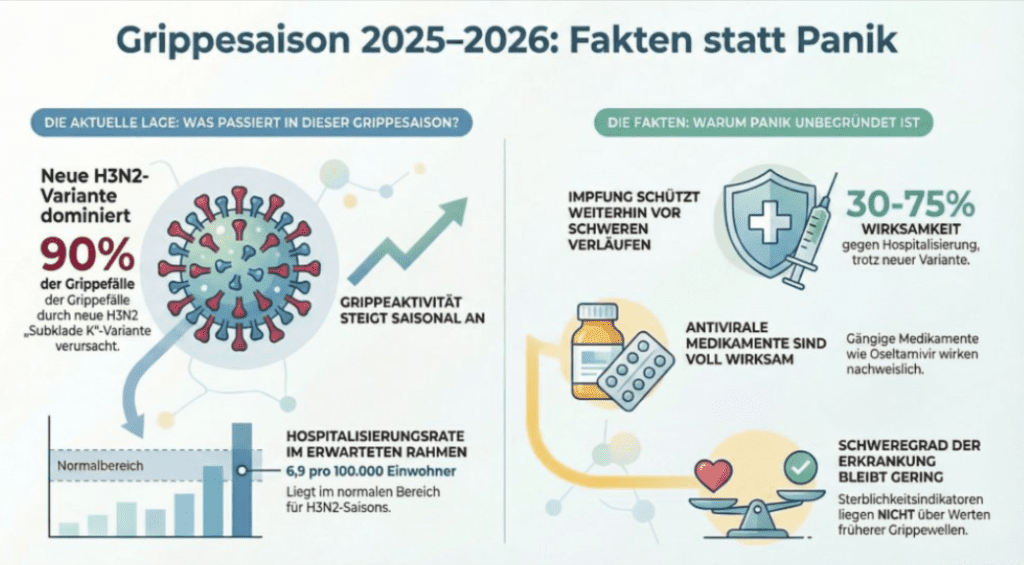
H3N2 has been an integral part of seasonal influenza viruses in humans since 1968. It is one of the most common subtypes and often causes stronger waves, especially in older people, because it adapts well. Subclade K is a
Important: There is no evidence of increased severity or virulence compared to previous H3N2 strains. Subclade K causes the same typical flu symptoms: fever, cough, sore throat, muscle pain, fatigue. Complications occur mainly in risk groups – just like in every flu season.
2. What is the current situation?
In the USA, flu activity has been rising steadily since October, similar to previous seasons. Until mid-December 2025:
- Hospitalisation rate: Cumulative approx. 6–7 per 100,000 inhabitants (most recently 3.5 per 100,000 per week) – this is a normal increase at this time of year.
- Child deaths: Only 3 reported in the US so far – tragic, but far below the numbers of past peaks.
- Positive rate on tests: Increasing, but within expected ranges.
- Dominance: Almost all influenza A cases are H3N2, the majority of which are subclade K.
Globally and in Europe, the season started 3-4 weeks earlier, with higher activity in some regions. But the WHO emphasizes: The activity remains
3. Does the vaccine still work?
Yes – and that is the crucial point against panic. The current vaccine for 2025/2026 contains an H3N2 component that was selected before the emergence of Subclade K. Laboratory tests show reduced reactivity (drift), but real data from England and Europe are encouraging:
- In children and adolescents: 70-75% protection against hospitalization.
- In adults: 30–40% protection against severe courses.
This is in the typical range for flu vaccines in H3N2-dominated seasons (historically 30-60%). The vaccine does not always prevent infection, but it significantly reduces the risk of serious illness, complications and death. Even in Mismatch, it provides cross-protection through existing immunity.
In addition: Antiviral drugs such as oseltamivir are fully effective against subclade K – no resistance found.
4. Why is panic inappropriate?
- Normal evolution: Influenza viruses mutate annually. Drifts like Subclade K are routine, no surprise. Pandemics are caused by major shifts (such as 1918 or 2009) – here it is only a small drift.
- Comparable seasons: Previous H3N2 waves (e.g., 2014/2015 or 2017/2018) had similar drifts and higher loads without systems collapsing.
- Severity remains the same: No data shows that subclade K is more dangerous. The higher attention comes from the early start and media focus.
- We are prepared: monitoring systems (CDC, WHO, ECDC) provide real-time data. Prevention works: vaccination, hygiene, early treatment.
Media alerts are often based on early trends or laboratory data, but ignore the clinical context. Experts from the WHO and CDC call for caution, not fear.
5. What can be done? Practical tips
- Get vaccinated: Still useful now! The protection builds up in 2 weeks and helps against severe courses.
- Protect risk groups: The elderly, the chronically ill, pregnant women, children – vaccinate early and contact a doctor if you have symptoms.
- Everyday measures: Wash your hands, cough into the crook of your arm, stay at home if you are sick, wear a mask in confined spaces.
- If you have symptoms: Drink a lot, rest, take antivirals early if there is a risk (preferably within 48 hours).
The flu affects millions of people every year – but it can be controlled with proven measures. H3N2 Subclade K is a variant, not a disaster. Therefore: Stay informed, but relaxed: Facts protect better than fear.
The article was originally published by LabNews.io. Responsible for the content: LabNews Media LLC
Editor: X-Press Journalistenbüro GbR
Gender Notice. The personal designations used in this text always refer equally to female, male and diverse persons. Double/triple naming and gendered designations are used for better readability. ected.
Most read
 Hantavirus: detection, symptoms, therapy What is hantavirus? Hantaviruses are a group of viruses that occur worldwide and are mainly transmit...
- Impending fuel shortage: “If the laboratory fails, medical care will come to a standstill in large parts” DGKL CEO Jan Wolter explains the dramatic consequences of a potential fuel shortage for laboratory m...
- Hantavirus: Facts instead of panic Reports of three deaths in connection with a hantavirus outbreak on the cruise ship "MV Hondius" in...