AOK expenditure on therapeutic products doubled within ten years
Expenditure on therapeutic products for AOK policyholders amounted to just under 4.8 billion euros in 2024, more than twice as much as in 2015 with 2.1 billion euros. This is shown by the Therapeutic Products Report 2025 of the Scientific Institute of the AOK.
Factors such as the volume effect or demographics played a negligible role in the increase in expenditure. Rather, the decisive factor was a new legal regulation for the nationwide harmonisation of the remuneration level in 2019. As a result, from 1 July 2019, the prices of the region with the highest remuneration were valid nationwide for the respective service items. In the years that followed, this maximum price was gradually replaced by nationwide supply contracts, which the National Association of Statutory Health Insurance Funds negotiated with the umbrella organisations of therapeutic product providers for each service area.
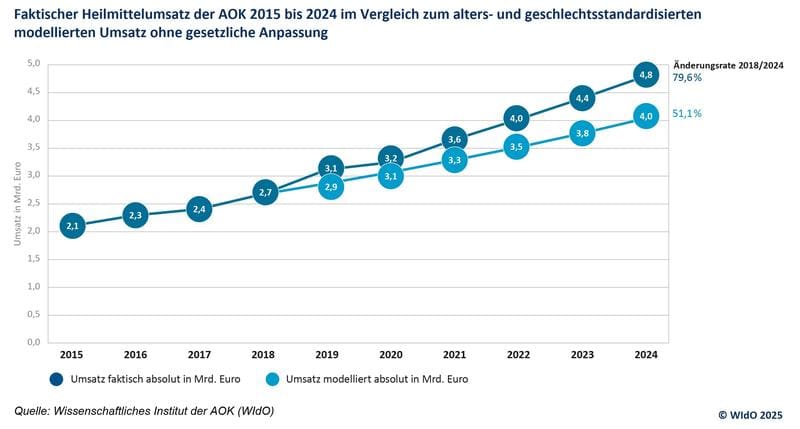
In a modelling process, the WIdO calculated the expenditure on therapeutic products that would have been achieved in 2024 if the legal adjustment had not taken place in 2019. The cost increases of therapeutic products in the six years before the new legal regulation and the changes in the age and gender structure of AOK insured persons were taken into account. According to the model calculation, expenditure on therapeutic products in 2024 would have been 4.03 billion euros, almost a fifth (18.9 percent) below the real turnover of 4.79 billion euros. “If the results of this model calculation of AOK expenditure on therapeutic products are applied to the statutory health insurance expenditure statistics, it can be assumed that the implementation of the highest reimbursements in 2019 for the statutory health insurance funds in 2024 has led to additional expenditure of more than 2.5 billion euros,” says Helmut Schröder, Managing Director of the Scientific Institute of the AOK (WIdO).
Original Paper:
Editor: X-Press Journalistenbüro GbR
Gender Notice. The personal designations used in this text always refer equally to female, male and diverse persons. Double/triple naming and gendered designations are used for better readability. ected.
Most read
 Hantavirus: detection, symptoms, therapy What is hantavirus? Hantaviruses are a group of viruses that occur worldwide and are mainly transmit...
- Impending fuel shortage: “If the laboratory fails, medical care will come to a standstill in large parts” DGKL CEO Jan Wolter explains the dramatic consequences of a potential fuel shortage for laboratory m...
- Hantavirus: Facts instead of panic Reports of three deaths in connection with a hantavirus outbreak on the cruise ship "MV Hondius" in...