INTRODUCING: Why an Indian PhD student in Coburg is looking for new biomarkers
At Coburg University of Applied Sciences, scientists are researching a therapy against elephantiasis, a tropical disease caused by parasitic worms. As part of an international doctoral project, Indian doctoral student Pavithra Rajkumar is looking for biological markers that are intended to optimize individual treatments. She is supported by a professor and the interdisciplinary doctoral center Analytics4Health.
Elephantiasis, also known as lymphatic filariasis, is caused by mosquito-borne parasites that block lymphatic vessels. This leads to severe swelling of the legs, arms, or genitals, tissue thickening, pain, and long-term movement restrictions. More than 120 million people worldwide are affected. The disease is one of the neglected tropical diseases and causes considerable suffering in affected regions.
The PhD student from SRM University AP in India has come to Germany to deepen her research. In a clinical study, she analyzes protein markers in the blood that reflect changes during treatment. The aim is to better understand the healing process and to adapt therapies. She cooperates with the Institute of Applied Dermatology in India, which has developed an integrative treatment concept. This concept has already shown success in the regression of chronic lymphoedema.
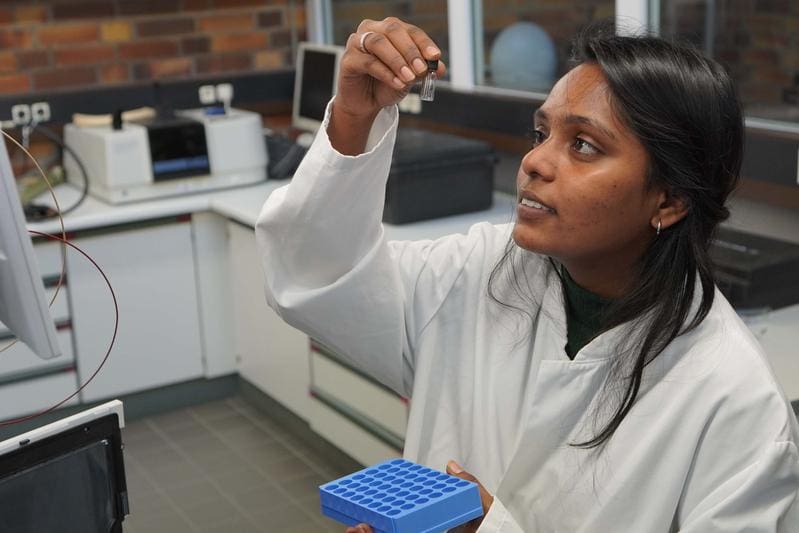
The research goes beyond simply verifying medical improvements and provides insights into the underlying mechanisms. Simple and reliable biomarkers are designed to monitor therapy progress and personalize treatments. The Analytics4Health doctoral center at Coburg University of Applied Sciences offers optimal conditions with its interdisciplinary orientation and cooperation with the Fraunhofer Institute for Cell Therapy and Immunology in Leipzig. There, the doctoral student will be trained in bioanalytical methods such as proteomics, mass spectrometry and bioelectrical impedance analysis.
The first few months in Germany were a change for Rajkumar. In addition to new research methods, scholarships, visas and accommodation had to be organised. The open atmosphere at Coburg University of Applied Sciences and the support of the mentoring team facilitated integration. In addition to laboratory work, she enjoys the quiet, culturally rich environment of Coburg, which offers a balance to her demanding work.
In the future, the doctoral student plans to expand her work to other areas and strengthen links between health and environmental protection. Its goal is to make contributions that help people and protect nature. The supervisioning professor, head of the Instrumental Bioanalytics research group, sees her as a committed young scientist at the interface of bioanalytics and medical technology. He supports the project with his expertise and international cooperation.
Through such initiatives, Coburg University of Applied Sciences builds bridges to global partners and supports talents in designing future solutions. SRM University AP is considered a young, excellently equipped and internationally oriented private university. The cooperation between India and Germany underlines the value of intercultural exchange in science.
Elephantiasis mainly affects poor regions in the tropics, where mosquitoes transmit the parasites. The search for biomarkers could revolutionize diagnosis and therapy, as current treatments are often lengthy and not always effective. With its concept, the Indian institute has shown that integrative approaches can reverse lymphedema. Coburg research complements this with analytical methods that quantify biological changes.
The Analytics4Health doctoral centre integrates disciplines such as biology, computer science and medicine. The cooperation with the Fraunhofer Institute provides access to state-of-the-art technology. Such projects strengthen Coburg University of Applied Sciences’ position in applied research and contribute to global health care.
In the long term, research could lead to personalized therapies that improve the chances of recovery. Biomarkers in the blood enable non-invasive monitoring and adaptation of treatments. This reduces the burden on patients and lowers costs in affected countries.
Editor: X-Press Journalistenbüro GbR
Gender Notice. The personal designations used in this text always refer equally to female, male and diverse persons. Double/triple naming and gendered designations are used for better readability. ected.
Most read
 Hantavirus: detection, symptoms, therapy What is hantavirus? Hantaviruses are a group of viruses that occur worldwide and are mainly transmit...
- Impending fuel shortage: “If the laboratory fails, medical care will come to a standstill in large parts” DGKL CEO Jan Wolter explains the dramatic consequences of a potential fuel shortage for laboratory m...
- Hantavirus: Facts instead of panic Reports of three deaths in connection with a hantavirus outbreak on the cruise ship "MV Hondius" in...