New sensor film revolutionizes early detection in bowel surgery
An interdisciplinary research team from the Technical University of Dresden (TUD), the University Medical Center Rostock (UMR) and the University Hospital Dresden has developed a groundbreaking, fully absorbable sensor film. For the first time, this enables real-time monitoring of circulatory disorders in intestinal anastomoses, a high-risk surgical procedure. The results were published in the journal “Advanced Science”.
Intestinal anastomoses, in which two sections of the intestine are connected after the removal of diseased tissue, are associated with high risks of postoperative complications. Circulatory disorders or immunological reactions can quickly lead to serious consequential damage or even death. Until now, there was no possibility of directly monitoring the suture, which often led to complex follow-up operations and long hospital stays. The research team, supported by the Else Kröner Fresenius Center (EKFZ) for Digital Health, developed a solution that detects complications at an early stage and minimizes consequential damage.
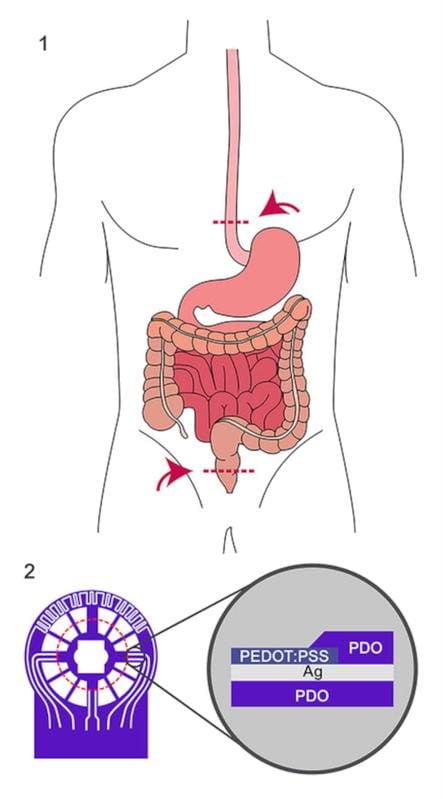
The novel sensor film is inserted into the intestinal suture during surgery and continuously measures tissue impedance and temperature. These parameters provide real-time data on the condition of the healing region. The team from the Dresden Integrated Center for Applied Physics and Photonic Materials (IAPP) at TUD developed biocompatible, printable electronic materials and manufacturing processes for this purpose. The UMR successfully implemented implantation into existing surgical procedures. Statistical analyses of several sensors showed that circulatory disorders caused by abrupt changes in electrical tissue resistance can be reliably detected.
The development placed high demands on the choice of material, as the film must not impair wound healing and is completely degraded by the body. Tests in the laboratory and in the body confirmed the functionality of the film. The close collaboration between surgeons and technologists has been crucial to its success. The project was funded by the German Research Foundation (DFG, 461264398, FAVORS) and the European Union (State Excellence Initiative ERDF: EXF-25-2010).
The researchers plan to broaden the study and add more features to the sensor film to better understand the causes of anastomotic failure. The technology could create the basis for smarter implants and significantly increase safety in surgery. This progress demonstrates the potential of interdisciplinary approaches that combine clinical need with technological innovation to sustainably improve patient care.
Original Paper:
Editor: X-Press Journalistenbüro GbR
Gender Notice. The personal designations used in this text always refer equally to female, male and diverse persons. Double/triple naming and gendered designations are used for better readability. ected.
Most read
 Hantavirus: detection, symptoms, therapy What is hantavirus? Hantaviruses are a group of viruses that occur worldwide and are mainly transmit...
- Impending fuel shortage: “If the laboratory fails, medical care will come to a standstill in large parts” DGKL CEO Jan Wolter explains the dramatic consequences of a potential fuel shortage for laboratory m...
- Hantavirus: Facts instead of panic Reports of three deaths in connection with a hantavirus outbreak on the cruise ship "MV Hondius" in...