
University of Basel discovers new approaches to severe muscle weakness
A team of researchers at the University of Basel has gained new insights into LAMA2 muscular dystrophy, a rare, incurable hereditary disease that mainly affects children. The study shows that in addition to progressive muscle atrophy, the ability of muscles to regenerate is also impaired, which could influence future therapies. The results were published in the journal “Nature Communications”.
The disease, which affects about eight out of a million children worldwide and 18 cases in Switzerland, is caused by a genetic defect that prevents the production of the protein laminin-α2. This protein normally stabilizes the outer supporting framework of muscle fibers. If it is missing, the fibers are damaged and degraded during everyday stress, leading to weakness, including the respiratory muscles. Many of those affected do not reach adulthood.
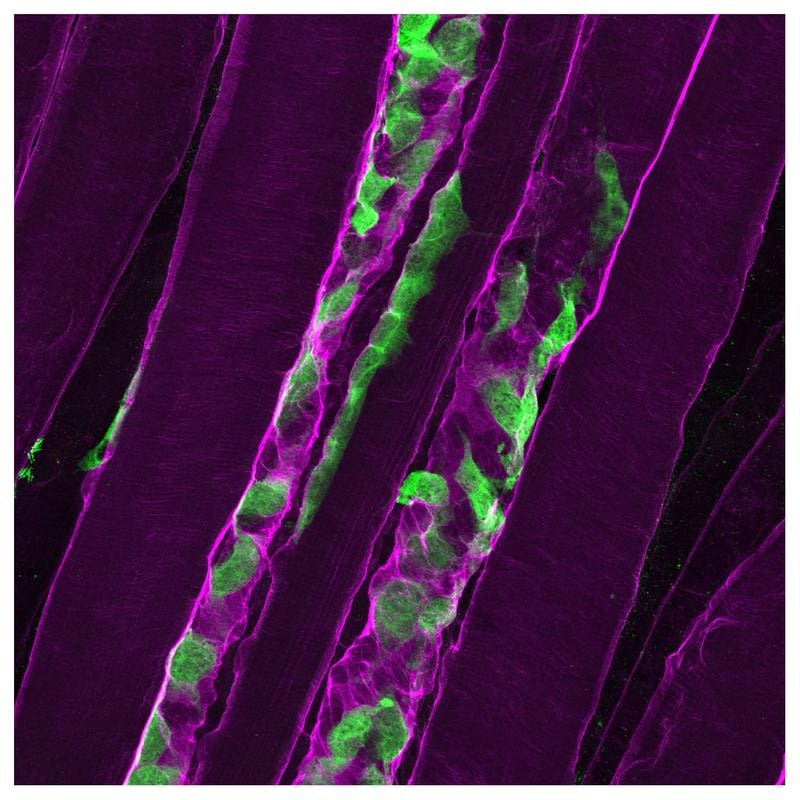
In collaboration with the Jagiellonian University in Krakow, the team led by Professor Markus Rüegg found that laminin-α2 is also crucial for the function of muscle stem cells. These cells are normally responsible for the formation of new muscle fibers after injuries. In healthy muscles, they produce laminin-α2 themselves to stimulate their division. In sick mice and human cells, however, it was shown that the deficiency of this protein slows down the division of stem cells, which means that regeneration after injury fails and muscle atrophy is accelerated.
Research suggests that future treatments should not only strengthen the stability of muscle fibers, but also promote the regenerative capacity of stem cells. This could alleviate symptoms and delay the progression of the disease by addressing both aspects of pathology.
Original Paper:
Timothy J. McGowan, Judith R. Reinhard, Nicolas Lewerenz, Marta Białobrzeska, Shuo Lin, Jacek Stępniewski, Krzysztof Szade, Józef Dulak, Markus A. Rüegg.
Loss of cell-autonomously secreted laminin-α2 drives muscle stem cell dysfunction in LAMA2-related muscular dystrophy.
Nature Communications (2025), doi: 10.1038/s41467-025-65703-1
Editor: X-Press Journalistenbüro GbR
Gender Notice. The personal designations used in this text always refer equally to female, male and diverse persons. Double/triple naming and gendered designations are used for better readability. ected.
Most read
 Wal Timmy: Environment Minister Backhaus ignored rescue technology that has been in place since 1983 The stranded humpback whale "Timmy" suffered severely for days in Mecklenburg-Western Pomerania beca...
- Wal Timmy: Germany’s problem with euthanasia EDITORIAL. Letting Timmy suffer is more due to the German lack of experience and the bureaucratic hu...
- Impending fuel shortage: “If the laboratory fails, medical care will come to a standstill in large parts” DGKL CEO Jan Wolter explains the dramatic consequences of a potential fuel shortage for laboratory m...